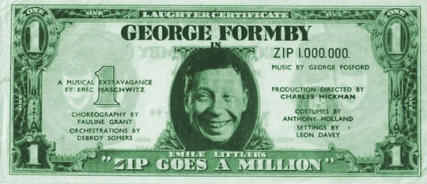
HENRY HALL PRESENTS ZIP GOES A MILLION
A 25 minute recording of Zip Goes A Million which was first
broadcast on Henry Hall’s Guest Night probably in 1951



In the years that followed
the end of World War II,
George Formby and his
music were not as
popular with the general
public. People were tired
of the war and all the
hardship and suffering
that they had endured
throughout the long
struggle. Even the great
Winston Churchill was
swept aside as people
searched for a fresh start
and a new beginning.
George Formby had made his last film in 1946 and after recording the songs
from this film he also stopped making records. George instead, decided that
his country still needed him and he toured the Commonwealth, working for
Britain in the same unstinting way that he had done throughout the war years.
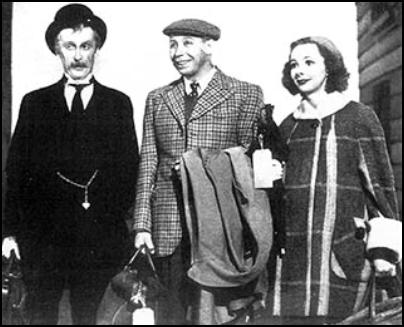
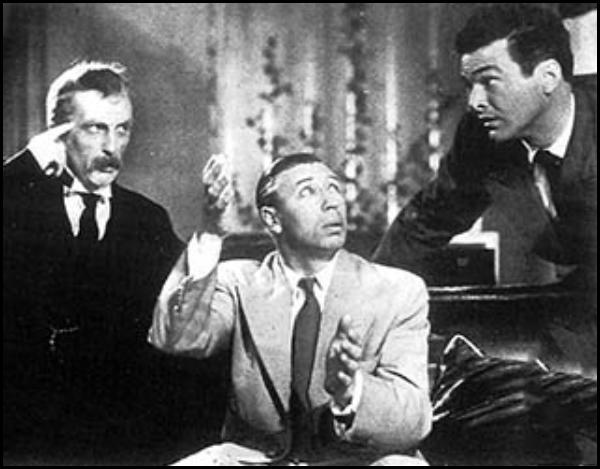
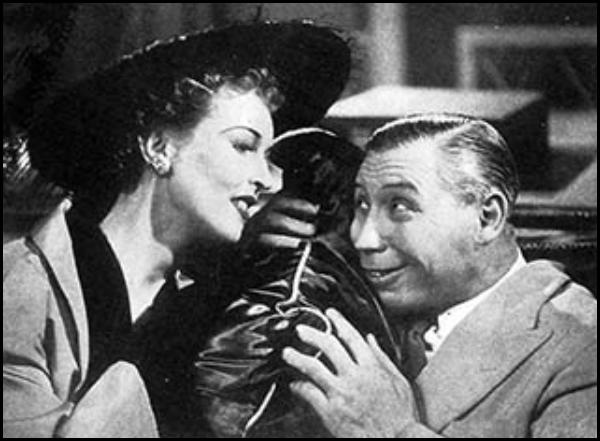
It was therefore a major challenge to George when he took on the role of Percy
Piggott in the musical production of "Zip Goes A Million", with the prospect of
taking the show in to the West End of London. George always assumed
(wrongly as it turned out) that his brand of humour was more suited to the
provinces and he thought that the more sophisticated theatre-going public in
the capital would never be comfortable with his homely brand of humour and
his cheeky songs.
From "THE BRITISH MUSICAL THEATRE -
VOLUME II - 1915 -1984" by KURT GÄNZL
Easily the most successful home-grown piece of 1951 was Zip Goes A Million,
a musical version of another popular play, the American comedy Brewsters
Millions, a hit of Broadway in 1906 and the following year in London.
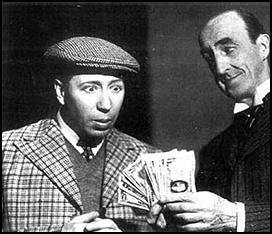
Brewsters Millions had for its hero, the simple Brewster who in order to inherit
a multi-million dollar fortune, is obliged to spend a million in double-quick time
without letting anyone know what he is up to.
It was a story which had plenty of comic scope, and Eric Maschwitz was able
to take advantage of all the best parts of this original play in composing his
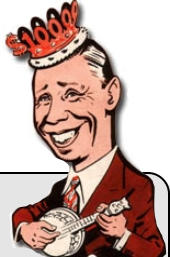
libretto around the popular figure of Lancashire variety and film star George
Formby, the gormless little fellow with the ukulele who had won his way into the
public's hearts.
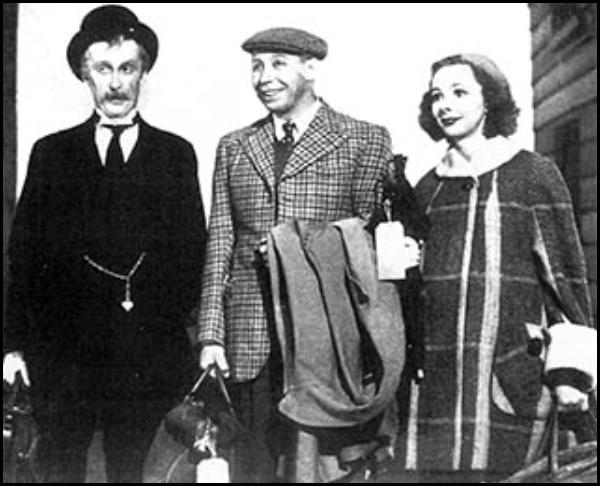
For Formby, Brewster became Percy Piggott, a Lancashire window cleaner (a
reference to his famous song "When I'm Cleaning Windows") whose attempts
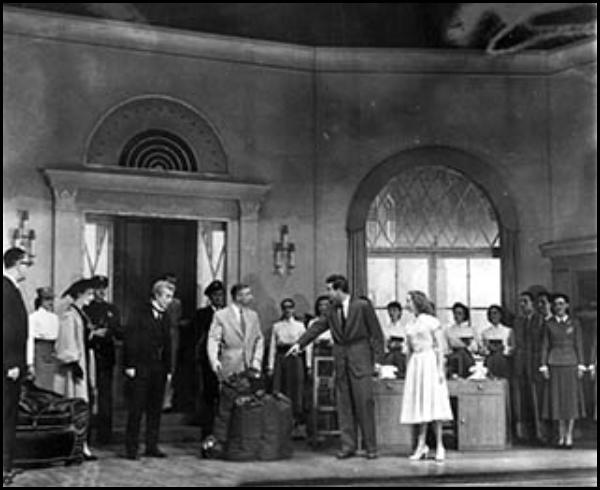
to spend his money in New York get him involved with the production of a
musical comedy, the stock market and the race track all of which against the
odds, insist on making him a profit.
Even the depredations of the shady banker Van Norden and his seductive
daughter fail to separate Percy from his money or from his uncomprehending
girlfriend Sally.
The second act, set in a good old fashioned way on a South Sea isle, has
Percy invoked with a yacht which he succeeds in getting smashed up and
salvaged at great expense while personal conflicts fly in all directions but,
finally he manages to get rid of the last dollars just in time for the fatal hour and
everything ends happily.
The music
The music was the work of George Posford and he, like Maschwitz, turned
turned out some of his brightest and most popular work for the occasion.
Formby did not monopolise the show's songs. A charming duet from Sally and
her father (Wallace Eaton) called "Trouble With My Heart" was, like Formby's
songs, in an English music-hall vein, but the other principal pieces were
featured by Warde Donovan and Barbara Perry as Buddy and Lila Delaney, the
American author and star respectively of Percy's musical, "Garter Girl."
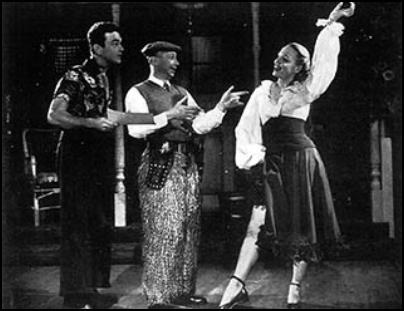
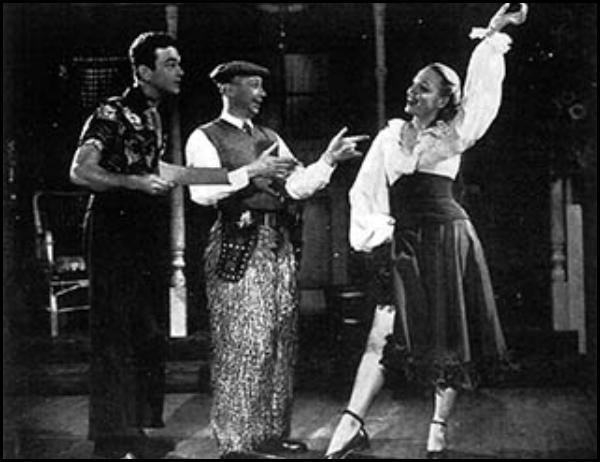
He featured with a line-up of South Pacific-like sailors in "Running Away To
Land" and in more romantic mood in "Nothing Breaks But The Heart" and "It
Takes No Time To Fall In Love", while she sang and danced 'The Story Of
Chiquita' and 'Garter Girl', sequences from the show within a show, as well as
joining her partner in two duets.
The numbers contrasted usefully with the homespun of the star numbers and
served to provide the show's production numbers.
First appearance
"Zip Goes A Million" made it's first appearance on the stage of the Hippodrome
Coventry, for a fortnight's season and progressed to Manchester where a
slimming process got the show ready for the Palace Theatre.
But union troubles once more threatened to scupper a new show, as Equity,
anxious not to be left behind the Musicians Union in such matters, instructed its
members not to work with American Barbara Perry in spite of the fact that she
had already appeared in London in "Starlight Roof".
Things were settled in time for the opening after inter-unions tantrums had
seemed likely for a while to do irreparable damage to the £40,000 production,
and Zip Goes A Million opened safely at the Palace on 20 October 1951,
confirming its out-of-town promise.
Formby scored the greatest success of his career, but the show was by no
means only him.
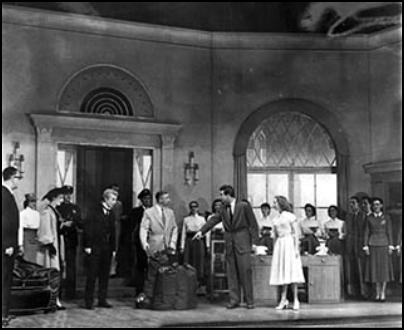
There was widespread praise for the 'tuneful songs' , 'lavish settings', 'humour
and tremendous speed', 'a production which is slickness itself' all of which
made what Theatre World rightly declared to be, 'a first-rate musical and a
sturdy rival for any importation from across the sea.
Ill health
Zip Goes A Million stayed in the West End alongside South Pacific for sixteen
months,yielding nothing to that piece in vigour or popularity.
Its star, alas, did not survive with it. Only six months into the run, George
Formby suffered a heart attack and was obliged to withdraw from the show.
He was replaced by another comedian, Reg ('Confidentially Yours') Dixon, who
saw the piece through to the end of its 544-performance run and then took it on
the road, starring opposite Pamela Charles, who had issued from the London
chorus where she had played as Pamela Foster.
Dixon toured in 1953 and 1954 before comic Charlie Chester took over the
subsequent tour.
These proliferating tours and later overseas productions from Norway to
Australia proved Zip Goes A Million to be a cheerfully comic entertainment
which could stand up solidly even without the star for whom it had been
created.
© Kurt Gänzl
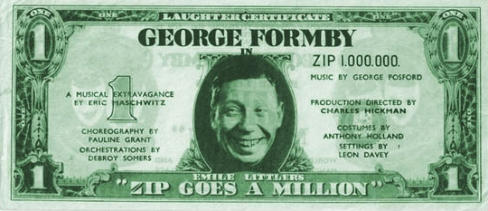
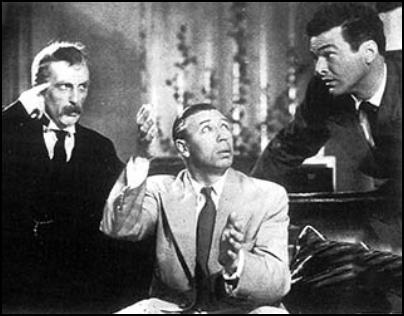
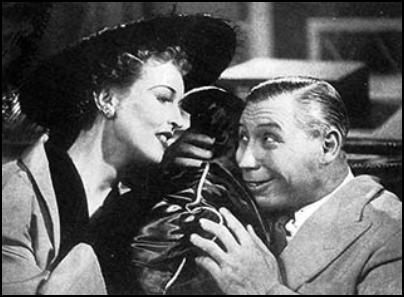
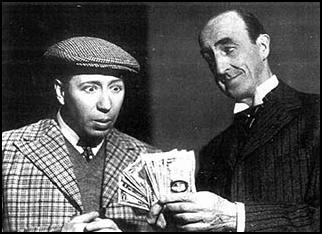
A musical extravaganza in two
acts by Erich Mashwitz,
adapted from Brewster's Millions by C.B. McCutcheon,
Windhill Smith and Byron Ongley.
Music by George Posford
Produced at the Hippodrome Theatre, Coventry under the
management of Emile Littler 4 September 1951 for 2
weeks and played at Manchester from 17 September 1951
for 4 weeks to 16 October 1951.
Opened at the Palace Theatre, London on 20 October
1951 for a run of 544 performances closing on 7 February
1953.
The Cast:
Kelly/Sheriff McOwen/Eddie/Principal Dancer - Ian Stuart
Lilac Delaney - Barbara Perry followed by Pamela Foster
(also called Pamela Charles)
Buddy Delaney - Warde Donovan
Jed Harper/Lefty/Wireless Op. - John Marquand
Motty Whittle - Wallace Eaton later Keith James
Sara Whittle - Sara Gregory
Percy Piggott - George Formby then Reg Dixon, on tour
Charlie Chester
George Connolly/Captain - Wilfred Caithness
Pamela Van Norden - Phoebe Kershaw
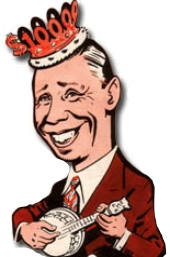
Zip Goes A Million
A stage triumph



In the years that followed the end of World War II, George Formby and his
music were not as popular with the general public. People were tired of
the war and all the
hardship and suffering
that they had endured
throughout the long
struggle. Even the great
Winston Churchill was
swept aside as people
searched for a fresh start
and a new beginning.
George Formby had
made his last film in 1946
and after recording the
songs from this film he
also stopped making
records. George instead,
decided that his country
still needed him and he toured the Commonwealth, working for Britain in
the same unstinting way that he had done throughout the war years.
It was therefore a major challenge to George when he took on the role of
Percy Piggott in the musical production of "Zip Goes A Million", with the
prospect of taking the show in to the West End of London. George always
assumed (wrongly as it turned out) that his brand of humour was more
suited to the provinces and he thought that the more sophisticated
theatre-going public in the capital would never be comfortable with his
homely brand of humour and his cheeky songs.
From "THE BRITISH MUSICAL THEATRE -
VOLUME II - 1915 -1984" by KURT GÄNZL
Easily the most successful home-grown piece of 1951 was Zip Goes A
Million, a musical version of another popular play, the American comedy
Brewsters Millions, a hit of Broadway in 1906 and the following year in
London.
Brewsters Millions had for its hero, the simple Brewster who in order to
inherit a multi-million dollar fortune, is obliged to spend a million in
double-quick time without letting anyone know what he is up to.
It was a story which had plenty of
comic scope, and Eric Maschwitz
was able to take advantage of all
the best parts of this original play
in composing his libretto around
the popular figure of Lancashire
variety and film star George
Formby, the gormless little fellow
with the ukulele who had won his
way into the public's hearts.
For Formby, Brewster became
Percy Piggott, a Lancashire
window cleaner (a reference to
his famous song "When I'm
Cleaning Windows") whose
attempts to spend his money in
New York get him involved with
the production of a musical
comedy, the stock market and the
race track all of which against the
odds, insist on making him a
profit.
Even the depredations of the
shady banker Van Norden and his
seductive daughter fail to
separate Percy from his money or
from his uncomprehending
girlfriend Sally.
The second act, set in a good old
fashioned way on a South Sea
isle, has Percy invoked with a
yacht which he succeeds in
getting smashed up and salvaged
at great expense while personal
conflicts fly in all directions but,
finally he manages to get rid of
the last dollars just in time for the
fatal hour and everything ends
happily.
The music
The music was the work of
George Posford and he, like
Maschwitz, turned turned out
some of his brightest and most
popular work for the occasion.
Formby did not monopolise the
show's songs. A charming duet
from Sally and her father (Wallace
Eaton) called "Trouble With My
Heart" was, like Formby's songs,
in an English music-hall vein, but
the other principal pieces were
featured by Warde Donovan and
Barbara Perry as Buddy and Lila
Delaney, the American author and
star respectively of Percy's
musical, "Garter Girl."
He featured with a line-up of South Pacific-like sailors in "Running Away
To Land" and in more romantic mood in "Nothing Breaks But The Heart"
and "It Takes No Time To Fall In Love", while she sang and danced 'The
Story Of Chiquita' and 'Garter Girl', sequences from the show within a
show, as well as joining her partner in two duets.
The numbers contrasted usefully with the homespun of the star numbers
and served to provide the show's production numbers.
First appearance
"Zip Goes A Million" made it's first appearance on the stage of the
Hippodrome Coventry, for a fortnight's season and progressed to
Manchester where a slimming process got the show ready for the Palace
Theatre.
But union troubles once more threatened to scupper a new show, as
Equity, anxious not to be left behind the Musicians Union in such matters,
instructed its members not to work with American Barbara Perry in spite
of the fact that she had already appeared in London in "Starlight Roof".
Things were settled in time for the opening after inter-unions tantrums
had seemed likely for a while to do irreparable damage to the £40,000
production, and Zip Goes A Million opened safely at the Palace on 20
October 1951, confirming its out-of-town promise.
Formby scored the greatest success of his career, but the show was by
no means only him.
There was widespread praise for the 'tuneful songs' , 'lavish settings',
'humour and tremendous speed', 'a production which is slickness itself' all
of which made what Theatre World rightly declared to be, 'a first-rate
musical and a sturdy rival for any importation from across the sea.
Ill health
Zip Goes A Million stayed in the West End alongside South Pacific for
sixteen months,yielding nothing to that piece in vigour or popularity.
Its star, alas, did not survive with it. Only six months into the run, George
Formby suffered a heart attack and was obliged to withdraw from the
show.
He was replaced by another comedian, Reg ('Confidentially Yours') Dixon,
who saw the piece through to the end of its 544-performance run and
then took it on the road, starring opposite Pamela Charles, who had
issued from the London chorus where she had played as Pamela Foster.
Dixon toured in 1953 and 1954 before comic Charlie Chester took over
the subsequent tour.
These proliferating tours and later overseas productions from Norway to
Australia proved Zip Goes A Million to be a cheerfully comic entertainment
which could stand up solidly even without the star for whom it had been
created.
© Kurt Gänzl
A musical extravaganza in two
acts by Erich Mashwitz,
adapted from Brewster's Millions by C.B. McCutcheon,
Windhill Smith and Byron Ongley.
Music by George Posford
Produced at the Hippodrome Theatre, Coventry under the
management of Emile Littler 4 September 1951 for 2
weeks and played at Manchester from 17 September 1951
for 4 weeks to 16 October 1951.
Opened at the Palace Theatre, London on 20 October
1951 for a run of 544 performances closing on 7 February
1953.
The Cast:
Kelly/Sheriff McOwen/Eddie/Principal Dancer - Ian Stuart
Lilac Delaney - Barbara Perry followed by Pamela Foster
(also called 111Pamela Charles)
Buddy Delaney - Warde Donovan
Jed Harper/Lefty/Wireless Op. - John Marquand
Motty Whittle - Wallace Eaton later Keith James
Sara Whittle - Sara Gregory
Percy Piggott - George Formby then Reg Dixon, on tour
Charlie Chester
George Connolly/Captain - Wilfred Caithness
Pamela Van Norden - Phoebe Kershaw
Zip Goes A Million


zip goes a million
A stage triumph

HENRY HALL PRESENTS ZIP GOES A MILLION
A 25 minute recording of Zip Goes A Million which was first
broadcast on Henry Hall’s Guest Night probably in 1951