jack cottrell

Songwriter and music hall artist, best remembered for Chinese Laundry Blues
1892 - 1945
John James “Jack” Cottrell 1892 to 1945
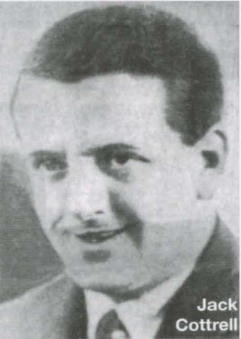
Songwriter and music hall artist, best remembered for Chinese Laundry Blues, made famous by George Formby John James Cottrell, known throughout his life as Jack, was an Oldham born music hall artist and songwriter, best remembered as the writer of Chinese Laundry Blues, the number George Formby made famous in the early 1930s. Until recently very little had been set down about Cottrell himself. Surviving civil, military and newspaper records now allow a clearer outline of his life, from Oldham and wartime service with the Army Service Corps, through the variety stage, to his death at Doncaster in 1945.Oldham and early life
He was born on 27 June 1892 at Oldham, Lancashire, the son of Arthur Blackburn Cottrell and his wife Betsy, and was baptised that July at St Paul’s, Oldham. The family knew him as James, the name that passed down to his grandchildren, but on paper he was John James, and to everyone he was Jack. His early life was a long way from the world of popular song. Before the First World War he worked in Oldham as a chauffeur, one of the new motor trades of the day.The First World War
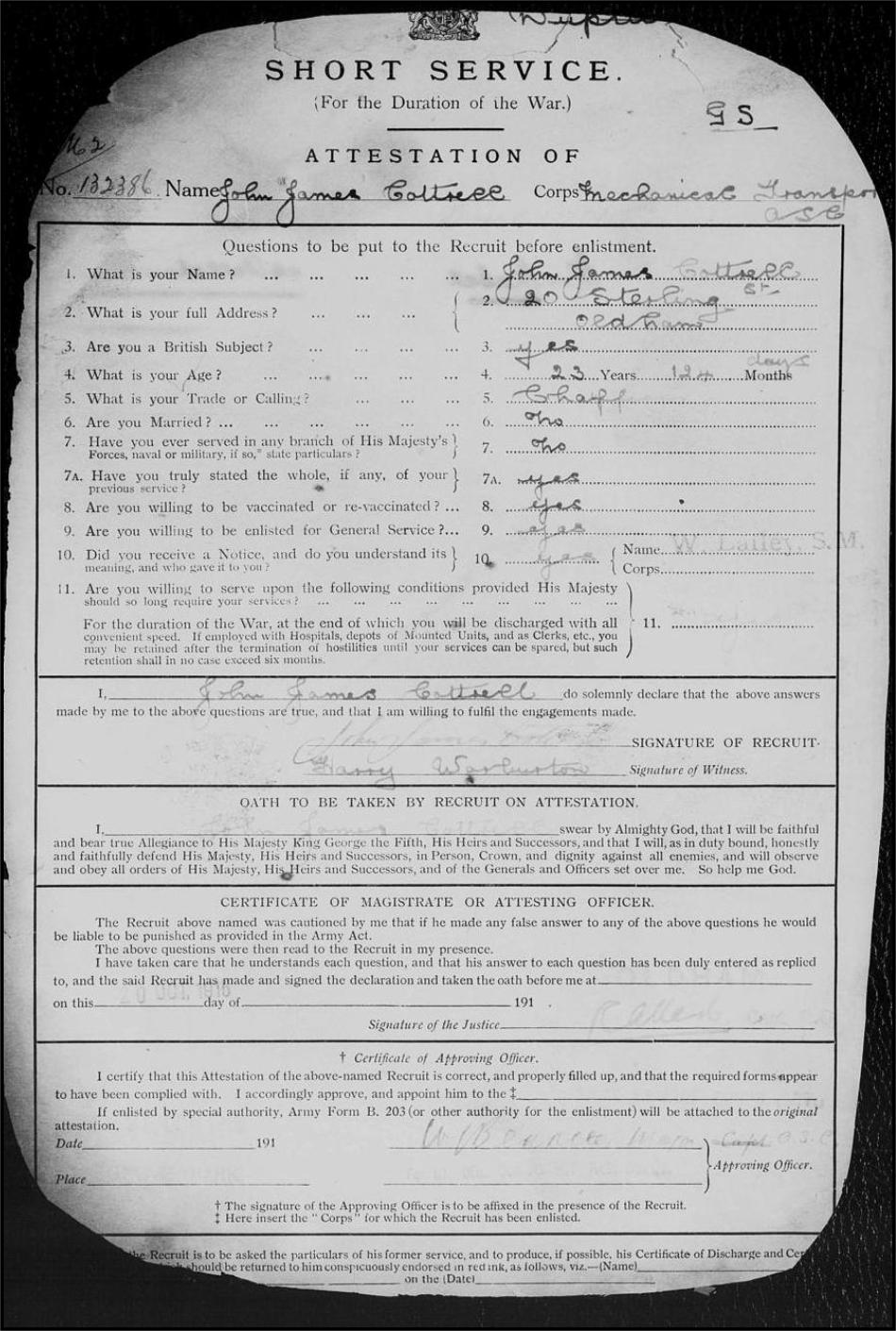
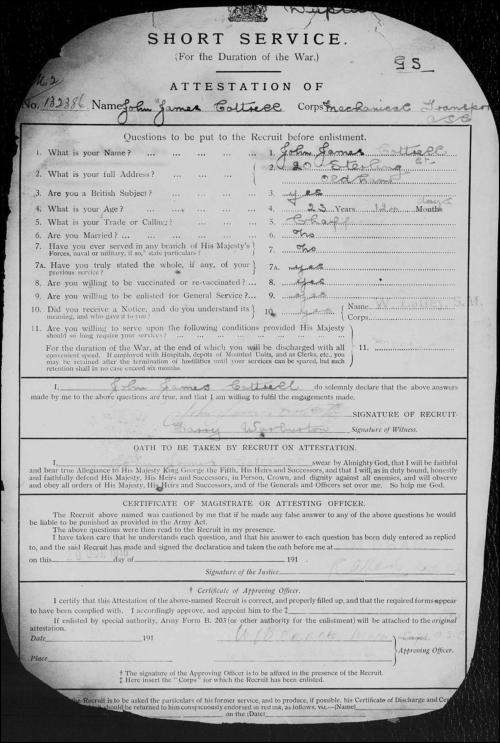
When war came, Cottrell enlisted in 1915, and the Army put his driving to use. He served with the Army Service Corps as a driver in mechanical transport, the branch that kept men and supplies moving by lorry, first at home and then in France, and was released to the Class Z Reserve in 1919. His service record survives among the so called burnt documents, the First World War files that survived the 1940 incendiary bombing of the War Office Record Centre in Arnside Street, Walworth, scorched but still legible. It gives his service number as 132386. Short service attestation, 20 October 1915. It records John James Cottrell of Oldham, aged 23, trade chauffeur. Army Service Corps record (WO 363).Marriage to Mabel Thorpe
In December 1918, while still in uniform, Cottrell married a young Oldham woman, Mabel Thorpe. The marriage is recorded on his service papers, and the couple had a son, Frank, born in 1923. It is a small fact with a long reach, because the marriage later explains a good deal about his private life.Music hall and Chinese Laundry Blues
Some time in the 1920s Cottrell left Oldham, and the motor trade, for the stage. He made his living in what we would now call the Tin Pan Alley world of inter-war British popular song, writing for the variety circuit and the music publishers. His lasting credit is Chinese Laundry Blues, written around 1932 and recorded by George Formby that summer. It became one of Formby’s signature numbers and introduced the comic character of Mr Wu, who would return in several later songs. The credit appears in the popular-music records of the period under more than one spelling, Jack Cottrell, Jack Cotterill and John Cotterill among them, the variations the publishers used. He is named in the 1974 Formby biography by Alan Randall and Ray Seaton, and the George Formby Society has long known him as the man behind the song. A public notice from 1939 puts his working life beyond doubt. Printed in The Stage, it records John James Cottrell, of 16 Smeaton Road, Upton, near Pontefract, applying to register under the Theatrical Employers Registration Act, and trading as Jack Cottrell, author and composer, of Cottrell’s Variety Agency. It is the clearest single link between the man on the certificates and the name on the songs. The Stage, June 1939. A registration notice naming John James Cottrell, trading as ‘Jack Cottrell, author, composer’ (Cottrell’s Variety Agency), of 16 Smeaton Road, Upton.Dorothy Sheepwash
and the 1930s
By the early 1930s Cottrell had formed a long partnership with Dorothy Kate Sheepwash, a dancer who had performed in London with the Tiller Girls. They lived together and had three children, Peter in 1931, June in 1932 and Dawn in 1935. By 1931 his marriage to Mabel Thorpe had broken down. Contemporary newspaper reports record maintenance proceedings in London that refer to another woman and a child, and other records indicate that the woman was Dorothy. No marriage between Cottrell and Sheepwash has been found, and his earlier marriage to Mabel explains why: he does not appear to have been legally free to marry. Their descendants have since helped to preserve the family memory of his connection with George Formby.Doncaster, 1945
Cottrell died on 15 June 1945 at the Royal Infirmary, Doncaster, twelve days before his fifty-third birthday. His death was registered with his occupation given in a single word, songwriter, and the informant was D. Cottrell, of the same address, the name Dorothy used. Chinese Laundry Blues outlived him, as good songs do, and is still heard in cover recordings today.Dorothy’s own account, 1992
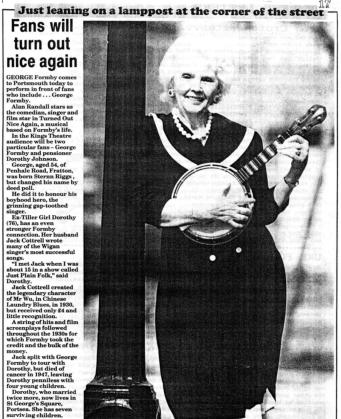
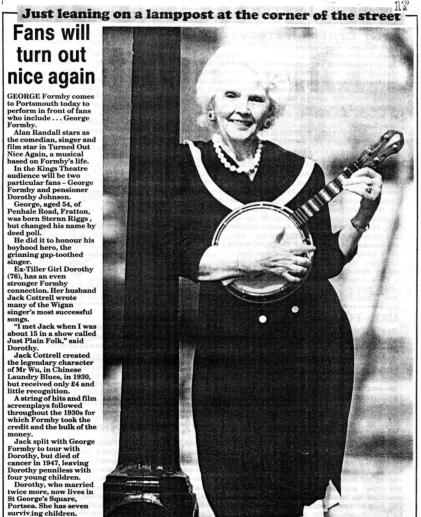
There is a coda. In the spring of 1992, long after Cottrell’s death, Dorothy told the story herself. A reporter from The Fareham News found her, by then a pensioner on the south coast, ahead of a touring Formby show, and she posed for a photograph with a ukulele. She recalled meeting Jack as a teenager, in a show called Just Plain Folk, and said that he had written Chinese Laundry Blues and created Mr Wu, for which, she remembered, he was paid four pounds. The documents found since, in birth registers, census pages and a soldier’s file, only confirm what she had carried in memory all along. Dorothy in 1992, photographed for The Fareham News with her banjo-ukulele and her George Formby memories.Sources and open questions
This outline rests on Cottrell’s 1892 birth registration and baptism at Oldham, his Army Service Corps service record, the registrations of his three children, the 1939 registration notice in The Stage, his 1945 Doncaster death certificate, and Dorothy’s 1992 interview. Questions remain. Cottrell and Mabel had a son, Frank, born in 1923; what became of mother and son afterwards is not yet known. The fuller record of his stage and songwriting career, in the trade papers and the Performing Right Society’s files, would add more.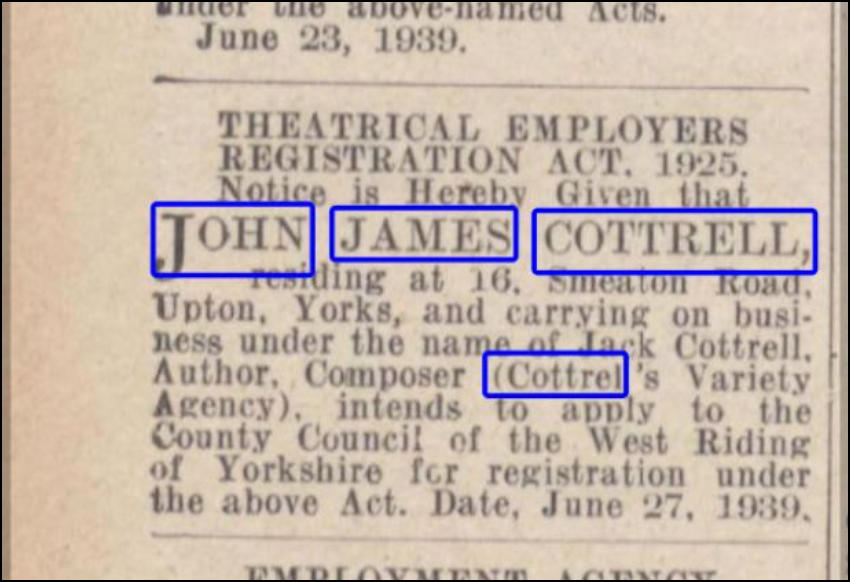
Chinese Laundry Blues
During a run of Mother Goose in1930 in which George Formby
played Billy Goose, a songwriter named Jack Cottrell came to see him in his dressing room and
picked out a tune on one of George's ukes.
Little did George know that this was to become his theme tune when he rejected the song. He bought
it two years later in 1932 after a second hearing and played it at a party he attended where it was
heard by Jack Hylton, the band Leader, who invited George to record the song as a B side to Do-De-0
-Do.
The recording was made on I July1932 at the Chenil Galleries studios, London, and when it was
released became an instant success earning George Formby enough in royalties in the first few
months to buy a Jaguar car.
Mr Wu was used by George in many other songs but this song more than any other heralded the
beginning of George's successful career in show business.
Jack Cottrell received £10 (£620 today) for his efforts and went on to write many more songs for
George including the unforgettable With My Little Ukulele In My Hand.
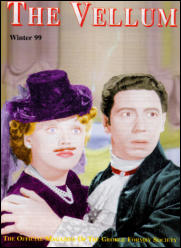
Vellum - Winter 1999
The Vellum View
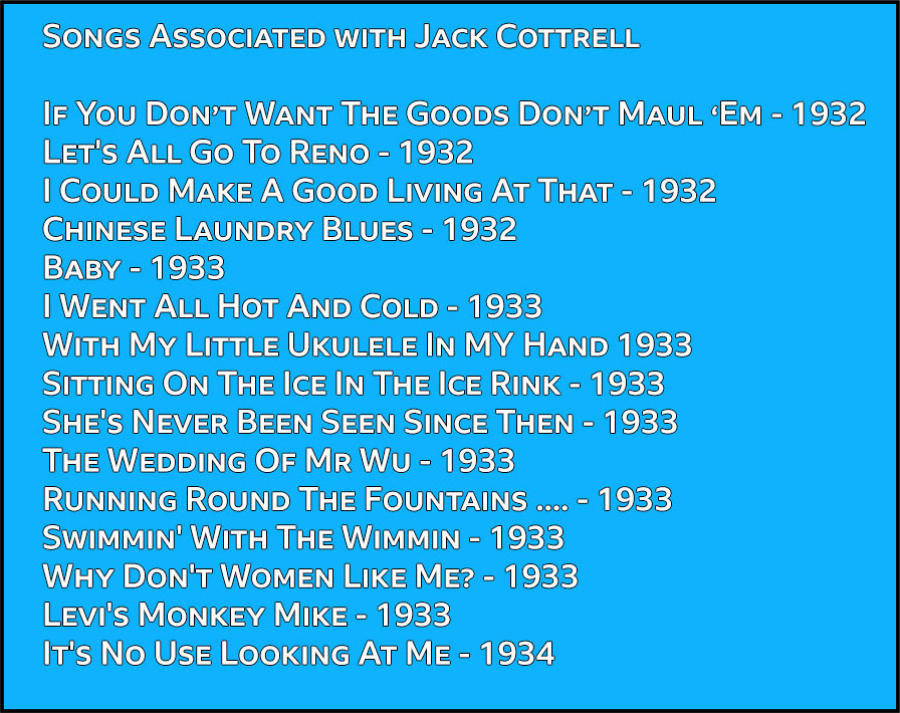
It’s No Use Looking At Me
This song was initially recorded by George on 22 April 1934, but the first two versions/takes 1 and 2
were rejected for some reason that has never been documented. He returned to the Thames Street
Studio on 12 June 1934 to record two further versions – takes 3 and 4 and it was the former that
found its way on to the original 78 record.
At this recording session, this was preceded by two further versions/takes of You Can’t Keep A
Growing Lad Down.
It’s No Use Looking At Me, which unfortunately has no uke solo, was also issued in Canada. As per
the record label, the song was written by Harry Gifford, Fred E Cliffe and Jack Cottrell but the name of
the band or orchestra is not known. The song was regarded by the ‘powers that be’ at the Decca
Recording Company as being commercially inferior to You Can’t Keep A Growing Lad Down and
therefore it was relegated to B side status. Fortunately the rejected take 2 has surfaced and the song
is taken at a slower pace with a different orchestral accompaniment. You can compare them by
listening to both versions. They are available on each of the 5 CD sets issued by the JSP Company.
The song is the only one that George recorded that featured the combined writing collaboration of
Messrs Gifford, Cliffe and Cottrell. Jack Cottrell was either solely or jointly responsible for writing the
majority of George’s songs during 1932 and 1933. Harry Gifford and Fred E Cliffe with or without
George Formby wrote the majority of songs recorded by George between 1934 and 1943.
Jon Baddeley - Summer 2017
Jack Haynes
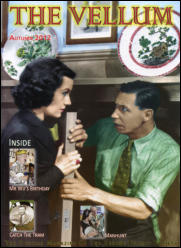
It was so pleasing to see Dorothy Johnson (Mrs Jack Cottrell. when I
knew her) in the Autumn issue of the Vellum. My story begins way back in
1941 when as a very young boy I was going on tour with film star Ernie
Lotinga in his new show called Old Soldiers Never Die. I would
sing and dance and I could play the piano just well enough to put over a
song but no solo. I needed help.
My dad heard of a man who could teach me the uke. He lived at 110
Becket St, Doncaster and he had written songs for GF. Without doubt he
was a · brilliant uke player and he agreed to teach me how to play and
also Write a song for me (I still own the original. manuscript) He charged
me a £5 fee and it was called •When The Lights Light Up" (Written and
composed by Jack Cottrell)
I went once every week, for 5 weeks, (Sunday) from Scunthorpe. I shall
never forget the kindness shown to me by Mrs Cottrell. She invited me to
have lunch with them every time and she taught me a dance routine. I am
very proud that when I performed the song and the dance routine at the
Gaumont State Cinema /Theatre I took 5 curtain calls and from then on
had some wonderful experiences working with and meeting many
international and home stars.
Vellum - Winter 1992
From Stanley King
At the time I was doing the clubs and pubs, with the ukulele, singing the Formby material.
One day, on the way to Pontefract Races, I stopped at a pub, and standing in the doorway was a chap
and he stopped me and asked if I would like to buy a copy of sheet music of a song called ' The Song
of The Pit' for sixpence, and some of the money would go to the local 'Miners Welfare Fund' .
I bought a copy and noticed that the song was written and composed by Jack Cottrell . Knowing that
Jack Cottrell was the man who wrote Formby's early hit songs, I was very interested to meet up with
him. I said, "I would like to meet Jack Cottrell, as I am using some of his Formby songs in the pubs and
clubs".
He took a sharp look at me and said, "Are you Boy King?" I said "Yes,". He replied, "You should not be
doing this, as the songs are written only for George Formby to sing". I said, "What is all this to do with
you?", I was flabbergasted when he replied, "I am Jack Cottrell!".
We then went into the pub and had a talk, and at that time he was no longer with Formby . I then asked
him if he would write songs for me, and he said, "Yes". I then invited him to come to the races with me,
and I bought the music copies he had left, there was about twenty, put them in the car and off we went.
From the races, we went to his home in Upton, where he introduced me to his wife, and as I
remembered, she was a tall, beautiful lady. Jack Cottrell came to my home in Leeds and wrote me
three songs.
The titles were: 'She's the kind of girl that makes good men go wrong', 'I always go further than that', to
which I added additional lyrics, and one song called 'Lying in the Hay'. The first two were successful,
but the last one I didn't use after a couple of tries.
At the time, Jack Cottrell came with me on my dates, and I would sing some of his Formby hits and then I would introduce him as the man
who helped George Formby on his way up the ladder of fame. Then he would come on, do a Uke song and then sing his 'Song of the Pit'. I
would then go round the audience selling the music copies.
Incidentally, Jack Cottrell worked under the name of 'Syd Ingham'. Sometime later, having now gone on the stage proper, I tried to contact
Jack and I was advised he was in the hospital with leg trouble. Then later I was told that Jack had passed away .
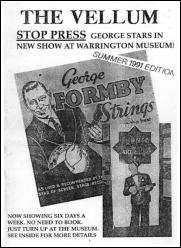
The Vellum - Summer 1991
From Jon Baddeley
Imagine you're living in the 1930s or 1940s. You're sitting in your house. You wind up the gramophone,
or if you're well off you plug a record player into the mains. You take the 78 record out of its cover and
place it on the turntable.
You're a fan of George Formby and you're eager to listen to his new song on his latest record.
Nearly 80 years ago on 01 July 1932, George went to the Decca Studios in London for the first time to
make what proved to be his first successful record.
The story begins with Chinese (Laundry) Blues which was recorded with the Jack Hylton Band on this
date. The song was written by Jack Cottrell who was responsible (or jointly) for composing 14 other
songs recorded by George between 1932 and 1934. Two versions were made. This was normal at
Decca due to the thinness of the shellac.
The song was also issued in Canada. An instrumental version was featured in the film Boots! Boots! in
which Beryl performed a tap dance accompanied by Harry Hudson and his Band.
Do De O Do was the A side of the record because it featured a trumpet solo by Nat Gonella. The original
version of Chinese (Laundry) Blues was also re-issued on the Rex record label in the mid-1930s, and a
short version was newly recorded on 8 May 1936 as part of The George Formby Medley.
It's said that George rejected the song back in 1922 because it was too jazz orientated.
When he heard the song for a second time he decided to include it in his ever-expanding repertoire. The
story goes that Jack Hylton heard George sing the song at a party and invited him to a recording session.
Hylton decided not to risk the inclusion of his own name on the record label fearing that the song would slide into obscurity. Eventually it
became George's theme music and the orchestra would strike up the tune as George came on to the stage.
It is interesting to note that at The Holborn Empire, George and Beryl appeared in a sketch entitled Night At Charlie Wong’s ten days before
the recording of Chinese (Laundry) Blues. I wonder if he included the song in the sketch. Perhaps we'll never know.
The Vellum - Autumn 2012
Singing The Blues
When George incorporated Chinese Laundry Blues into his act in 1929 the people loved it.
However, one night in Salford the Watch Committee banned him from singing it, but the audience was
so insistent that he ignored the ban.
Although the song was popular, it was another four years before he recorded it with Jack Hylton's band.
By then it had become his favourite number.
The odd thing is that: Jack Hylton has no credits on the label.
One report says that Jack didn 't like the song and didn't want to be associated with it.
Another says that he was enthusiastic, having played it in a Blackpool show and also heard George sing
it at a show-biz
party in London. Jack asked George to record it with him and he did so on I July 1932 in London.
George said, "He wouldn't allow his name to appear on the label and insisted that I take all the credit."
George bought a car out of the royalties and it led to more recording contracts and a lucrative career.
Jack Cottrell who wrote the song got four quid.
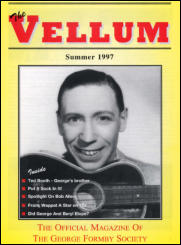
The Vellum - Summer 1997
Given The Credit
Betty Driver's name appears in the credits of George Formby's first film
Boots! Boots! even though she wasn't in it!
In 1933, Coronation Street's Betty Turpin was a 12 year-old starlet. George spotted her talent and gave
her a spot in the film .
Betty: " I was so thrilled to get such a big chance to star with George Formby.
Jack Cottrell wrote the screenplay and had also written a tune called Chinese Laundry Blues and I had
a dance routine to go with it.
"My mother took me to London to do a rehearsal with the band and it all seemed to go very well. Then
when it was over we all heard someone shout out from the back: 'Either that kid goes or I do'.
" lt was Beryl!"
They were all very apologetic but it didn' t make any difference. It wasn't the first time that this kind of
thing had happened. If ever a chorus girl made eyes at George, Beryl would get rid of her.
In the end, it seems that no one could be found who Beryl was happy with so she took over Betty's role
herself and the film was released.
It was reported that 'Beryl Formby, a champion clog-dancer, performed a
notable tap dance'.
But it was too late to take Betty's name off the film credits.
The Vellum - Summer 1997

The words above were penned by Rob Stewart, the
grandson of the lovely lady in the photo above,
Dorothy Cottrell, wife of Jack Cottrell.
The page above is available to download as a PDF file by
clicking on the image


1892 - 1945
John James “Jack” Cottrell 1892 to 1945
Songwriter and music hall artist, best remembered for Chinese Laundry Blues, made famous by George Formby John James Cottrell, known throughout his life as Jack, was an Oldham born music hall artist and songwriter, best remembered as the writer of Chinese Laundry Blues, the number George Formby made famous in the early 1930s. Until recently very little had been set down about Cottrell himself. Surviving civil, military and newspaper records now allow a clearer outline of his life, from Oldham and wartime service with the Army Service Corps, through the variety stage, to his death at Doncaster in 1945.Oldham and early life
He was born on 27 June 1892 at Oldham, Lancashire, the son of Arthur Blackburn Cottrell and his wife Betsy, and was baptised that July at St Paul’s, Oldham. The family knew him as James, the name that passed down to his grandchildren, but on paper he was John James, and to everyone he was Jack. His early life was a long way from the world of popular song. Before the First World War he worked in Oldham as a chauffeur, one of the new motor trades of the day.The First World War
When war came, Cottrell enlisted in 1915, and the Army put his driving to use. He served with the Army Service Corps as a driver in mechanical transport, the branch that kept men and supplies moving by lorry, first at home and then in France, and was released to the Class Z Reserve in 1919. His service record survives among the so called burnt documents, the First World War files that survived the 1940 incendiary bombing of the War Office Record Centre in Arnside Street, Walworth, scorched but still legible. It gives his service number as 132386. Short service attestation, 20 October 1915. It records John James Cottrell of Oldham, aged 23, trade chauffeur. Army Service Corps record (WO 363).Marriage to Mabel Thorpe
In December 1918, while still in uniform, Cottrell married a young Oldham woman, Mabel Thorpe. The marriage is recorded on his service papers, and the couple had a son, Frank, born in 1923. It is a small fact with a long reach, because the marriage later explains a good deal about his private life.Music hall and Chinese Laundry Blues
Some time in the 1920s Cottrell left Oldham, and the motor trade, for the stage. He made his living in what we would now call the Tin Pan Alley world of inter-war British popular song, writing for the variety circuit and the music publishers. His lasting credit is Chinese Laundry Blues, written around 1932 and recorded by George Formby that summer. It became one of Formby’s signature numbers and introduced the comic character of Mr Wu, who would return in several later songs. The credit appears in the popular-music records of the period under more than one spelling, Jack Cottrell, Jack Cotterill and John Cotterill among them, the variations the publishers used. He is named in the 1974 Formby biography by Alan Randall and Ray Seaton, and the George Formby Society has long known him as the man behind the song. A public notice from 1939 puts his working life beyond doubt. Printed in The Stage, it records John James Cottrell, of 16 Smeaton Road, Upton, near Pontefract, applying to register under the Theatrical Employers Registration Act, and trading as Jack Cottrell, author and composer, of Cottrell’s Variety Agency. It is the clearest single link between the man on the certificates and the name on the songs. The Stage, June 1939. A registration notice naming John James Cottrell, trading as ‘Jack Cottrell, author, composer’ (Cottrell’s Variety Agency), of 16 Smeaton Road, Upton.Dorothy Sheepwash and the 1930s
By the early 1930s Cottrell had formed a long partnership with Dorothy Kate Sheepwash, a dancer who had performed in London with the Tiller Girls. They lived together and had three children, Peter in 1931, June in 1932 and Dawn in 1935. By 1931 his marriage to Mabel Thorpe had broken down. Contemporary newspaper reports record maintenance proceedings in London that refer to another woman and a child, and other records indicate that the woman was Dorothy. No marriage between Cottrell and Sheepwash has been found, and his earlier marriage to Mabel explains why: he does not appear to have been legally free to marry. Their descendants have since helped to preserve the family memory of his connection with George Formby.Doncaster, 1945
Cottrell died on 15 June 1945 at the Royal Infirmary, Doncaster, twelve days before his fifty-third birthday. His death was registered with his occupation given in a single word, songwriter, and the informant was D. Cottrell, of the same address, the name Dorothy used. Chinese Laundry Blues outlived him, as good songs do, and is still heard in cover recordings today.Dorothy’s own account, 1992
There is a coda. In the spring of 1992, long after Cottrell’s death, Dorothy told the story herself. A reporter from The Fareham News found her, by then a pensioner on the south coast, ahead of a touring Formby show, and she posed for a photograph with a ukulele. She recalled meeting Jack as a teenager, in a show called Just Plain Folk, and said that he had written Chinese Laundry Blues and created Mr Wu, for which, she remembered, he was paid four pounds. The documents found since, in birth registers, census pages and a soldier’s file, only confirm what she had carried in memory all along. Dorothy in 1992, photographed for The Fareham News with her banjo-ukulele and her George Formby memories.Sources and open questions
This outline rests on Cottrell’s 1892 birth registration and baptism at Oldham, his Army Service Corps service record, the registrations of his three children, the 1939 registration notice in The Stage, his 1945 Doncaster death certificate, and Dorothy’s 1992 interview. Questions remain. Cottrell and Mabel had a son, Frank, born in 1923; what became of mother and son afterwards is not yet known. The fuller record of his stage and songwriting career, in the trade papers and the Performing Right Society’s files, would add more.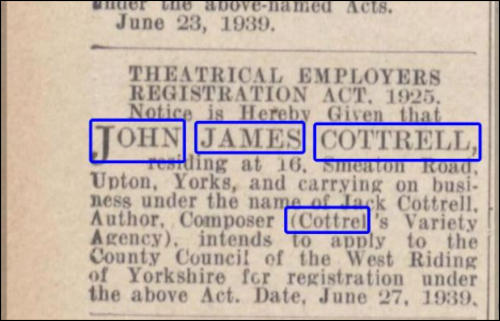
The Vellum View
Given The Credit
Betty Driver's name appears in the
credits of George Formby's first film
Boots! Boots! even though she wasn't
in it!
In 1933, Coronation Street's Betty
Turpin was a 12 year-old starlet.
George spotted her talent and gave
her a spot in the film .
Betty: " I was so thrilled to get such a
big chance to star with George
Formby.
Jack Cottrell wrote the screenplay and
had also written a tune called Chinese
Laundry Blues and I had a dance
routine to go with it.
"My mother took me to London to do a rehearsal with the band and
it all seemed to go very well. Then when it was over we all heard
someone shout out from the back: 'Either that kid goes or I do'.
" lt was Beryl!"
They were all very apologetic but it didn' t make any difference. It
wasn't the first time that this kind of thing had happened. If ever a
chorus girl made eyes at George, Beryl would get rid of her.
In the end, it seems that no one could be found who Beryl was
happy with so she took over Betty's role herself and the film was
released.
It was reported that 'Beryl Formby, a champion clog-dancer,
performed a
notable tap dance'.
But it was too late to take Betty's name off the film credits.
The Vellum - Summer 1997
jack cottrell
Songwriter and Music Hall artist

It’s No Use Looking At Me
This song was initially recorded by
George on 22 April 1934, but the first
two versions/takes 1 and 2 were
rejected for some reason that has
never been documented. He returned
to the Thames Street Studio on 12
June 1934 to record two further
versions – takes 3 and 4 and it was
the former that found its way on to the
original 78 record.
At this recording session, this was
preceded by two further
versions/takes of You Can’t Keep A
Growing Lad Down.
It’s No Use Looking At Me, which unfortunately has no uke solo,
was also issued in Canada. As per the record label, the song
was written by Harry Gifford, Fred E Cliffe and Jack Cottrell but
the name of the band or orchestra is not known. The song was
regarded by the ‘powers that be’ at the Decca Recording
Company as being commercially inferior to You Can’t Keep A
Growing Lad Down and therefore it was relegated to B side
status. Fortunately the rejected take 2 has surfaced and the
song is taken at a slower pace with a different orchestral
accompaniment. You can compare them by listening to both
versions. They are available on each of the 5 CD sets issued by
the JSP Company.
The song is the only one that George recorded that featured the
combined writing collaboration of Messrs Gifford, Cliffe and
Cottrell. Jack Cottrell was either solely or jointly responsible for
writing the majority of George’s songs during 1932 and 1933.
Harry Gifford and Fred E Cliffe with or without George Formby
wrote the majority of songs recorded by George between 1934
and 1943.
Jon Baddeley - Summer 2017
Jack Haynes
It was so pleasing to see
Dorothy Johnson (Mrs Jack
Cottrell. when I knew her) in
the Autumn issue of the
Vellum. My story begins
way back in 1941 when as
a very young boy I was
going on tour with film star
Ernie Lotinga in his new
show called Old Soldiers
Never Die. I would
sing and dance and I could
play the piano just well enough to put over a song but no solo. I
needed help.
My dad heard of a man who could teach me the uke. He lived at
110 Becket St, Doncaster and he had written songs for GF.
Without doubt he was a · brilliant uke player and he agreed to
teach me how to play and also Write a song for me (I still own the
original. manuscript) He charged me a £5 fee and it was called
•When The Lights Light Up" (Written and composed by Jack
Cottrell)
I went once every week, for 5 weeks, (Sunday) from Scunthorpe. I
shall never forget the kindness shown to me by Mrs Cottrell. She
invited me to have lunch with them every time and she taught me
a dance routine. I am very proud that when I performed the song
and the dance routine at the Gaumont State Cinema /Theatre I
took 5 curtain calls and from then on had some wonderful
experiences working with and meeting many international and
home stars.
Vellum - Winter 1992
From Stanley King
At the time I was doing the clubs and
pubs, with the ukulele, singing the
Formby material.
One day, on the way to Pontefract
Races, I stopped at a pub, and
standing in the doorway was a chap
and he stopped me and asked if I
would like to buy a copy of sheet music
of a song called ' The Song of The Pit'
for sixpence, and some of the money
would go to the local 'Miners Welfare
Fund' .
I bought a copy and noticed that the
song was written and composed by
Jack Cottrell . Knowing that Jack
Cottrell was the man who wrote
Formby's early hit songs, I was very interested to meet up with
him. I said, "I would like to meet Jack Cottrell, as I am using some
of his Formby songs in the pubs and clubs".
He took a sharp look at me and said, "Are you Boy King?" I said
"Yes,". He replied, "You should not be doing this, as the songs are
written only for George Formby to sing". I said, "What is all this to
do with you?", I was flabbergasted when he replied, "I am Jack
Cottrell!".
We then went into the pub and had a talk, and at that time he was
no longer with Formby . I then asked him if he would write songs
for me, and he said, "Yes". I then invited him to come to the races
with me, and I bought the music copies he had left, there was
about twenty, put them in the car and off we went.
From the races, we went to his home in Upton, where he
introduced me to his wife, and as I remembered, she was a tall,
beautiful lady. Jack Cottrell came to my home in Leeds and wrote
me three songs.
The titles were: 'She's the kind of girl that makes good men go
wrong', 'I always go further than that', to which I added additional
lyrics, and one song called 'Lying in the Hay'. The first two were
successful, but the last one I didn't use after a couple of tries.
At the time, Jack Cottrell came with me on my dates, and I would
sing some of his Formby hits and then I would introduce him as
the man who helped George Formby on his way up the ladder of
fame. Then he would come on, do a Uke song and then sing his
'Song of the Pit'. I would then go round the audience selling the
music copies.
Incidentally, Jack Cottrell worked under the name of 'Syd Ingham'.
Sometime later, having now gone on the stage proper, I tried to
contact Jack and I was advised he was in the hospital with leg
trouble. Then later I was told that Jack had passed away .
The Vellum - Summer 1991
From Jon Baddeley
Imagine you're living in the 1930s or
1940s. You're sitting in your house.
You wind up the gramophone, or if
you're well off you plug a record player
into the mains. You take the 78 record
out of its cover and place it on the
turntable.
You're a fan of George Formby and
you're eager to listen to his new song
on his latest record.
Nearly 80 years ago on 01 July 1932,
George went to the Decca Studios in
London for the first time to make what
proved to be his first successful
record.
The story begins with Chinese (Laundry) Blues which was
recorded with the Jack Hylton Band on this date. The song was
written by Jack Cottrell who was responsible (or jointly) for
composing 14 other songs recorded by George between 1932 and
1934. Two versions were made. This was normal at Decca due to
the thinness of the shellac.
The song was also issued in Canada. An instrumental version was
featured in the film Boots! Boots! in which Beryl performed a tap
dance accompanied by Harry Hudson and his Band.
Do De O Do was the A side of the record because it featured a
trumpet solo by Nat Gonella. The original version of Chinese
(Laundry) Blues was also re-issued on the Rex record label in the
mid-1930s, and a short version was newly recorded on 8 May
1936 as part of The George Formby Medley.
It's said that George rejected the song back in 1922 because it
was too jazz orientated.
When he heard the song for a second time he decided to include it
in his ever-expanding repertoire. The story goes that Jack Hylton
heard George sing the song at a party and invited him to a
recording session.
Hylton decided not to risk the inclusion of his own name on the
record label fearing that the song would slide into obscurity.
Eventually it became George's theme music and the orchestra
would strike up the tune as George came on to the stage.
It is interesting to note that at The Holborn Empire, George and
Beryl appeared in a sketch entitled Night At Charlie Wong’s ten
days before the recording of Chinese (Laundry) Blues. I wonder if
he included the song in the sketch. Perhaps we'll never know.
The Vellum - Autumn 2012
Chinese Laundry Blues
During a run of Mother Goose in1930
in which George Formby
played Billy Goose, a songwriter
named Jack Cottrell came to see him in
his dressing room and picked out a
tune on one of George's ukes.
Little did George know that this was to
become his theme tune when he
rejected the song. He bought it two
years later in 1932 after a second
hearing and played it at a party he
attended where it was heard by Jack
Hylton, the band Leader, who invited
George to record the song as a B side
to Do-De-0 -Do.
The recording was made on I July1932 at the Chenil Galleries
studios, London, and when it was released became an instant
success earning George Formby enough in royalties in the first few
months to buy a Jaguar car.
Mr Wu was used by George in many other songs but this song
more than any other heralded the beginning of George's successful
career in show business.
Jack Cottrell received £10 (£620 today) for his efforts and went on
to write many more songs for George including the unforgettable
With My Little Ukulele In My Hand.
Vellum - Winter 1999
Singing The Blues
When George incorporated Chinese
Laundry Blues into his act in 1929 the
people loved it.
However, one night in Salford the
Watch Committee banned him from
singing it, but the audience was so
insistent that he ignored the ban.
Although the song was popular, it was
another four years before he recorded
it with Jack Hylton's band. By then it
had become his favourite number.
The odd thing is that: Jack Hylton has
no credits on the label.
One report says that Jack didn 't like
the song and didn't want to be
associated with it.
Another says that he was enthusiastic, having played it in a
Blackpool show and also heard George sing it at a show-biz
party in London. Jack asked George to record it with him and he
did so on I July 1932 in London.
George said, "He wouldn't allow his name to appear on the label
and insisted that I take all the credit."
George bought a car out of the royalties and it led to more
recording contracts and a lucrative career.
Jack Cottrell who wrote the song got four quid.
The Vellum - Summer 1997

The words above were penned by Rob Stewart, the
grandson of the lovely lady in the photo above,
Dorothy Cottrell, wife of Jack Cottrell.
The page above is available to download as a PDF file by
clicking on the image


