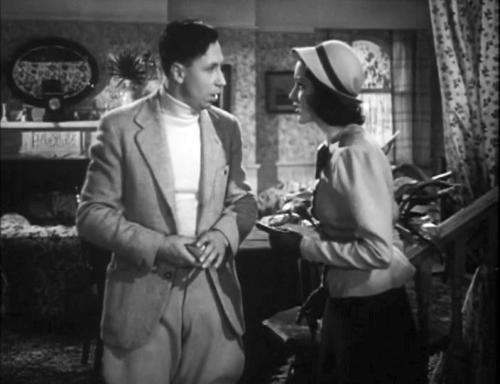
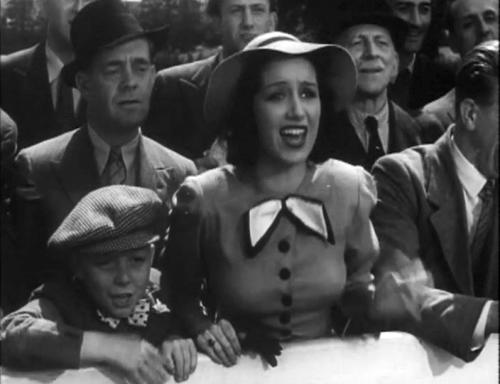
Star of COME ON GEORGE
by Eleanor Dugan
When 18-year-old singing sensation Pat Kirkwood was signed to appear
in Let George Do It, she assumed she'd have a solo or two. "No," she
was told. Well, her agent insisted, at least a duet with George? Again,
"No."
This was just the beginning. Although Miss Kirkwood had already
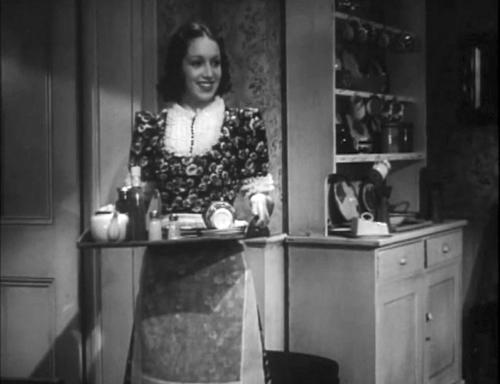
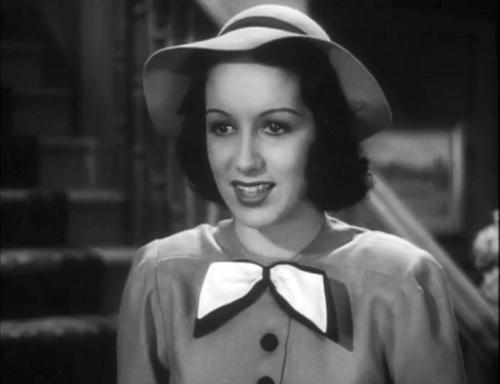
appeared in two films, Beryl Formby insisted that her long hair had to be
cropped, her glamorous makeup subdued, and her wardrobe confined to
"country jumble sale" rejects. Not knowing about Beryl's jealousy, she
attributed George Formby's reticence on the set to her "frightening"
appearance.
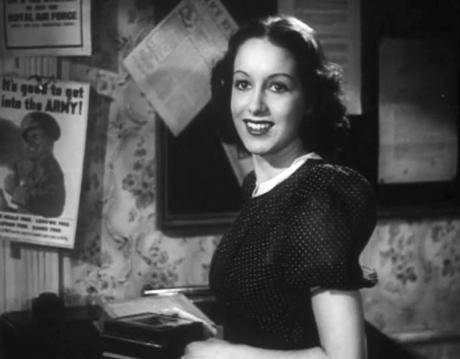
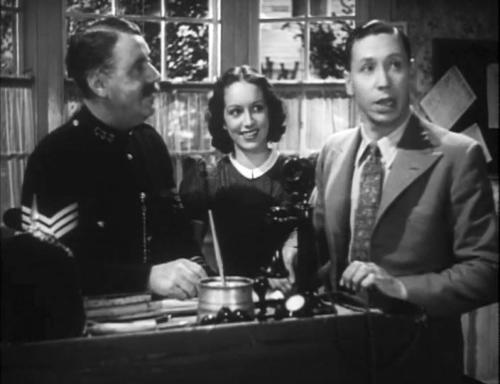
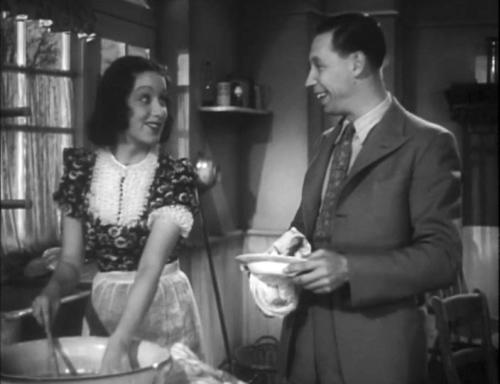
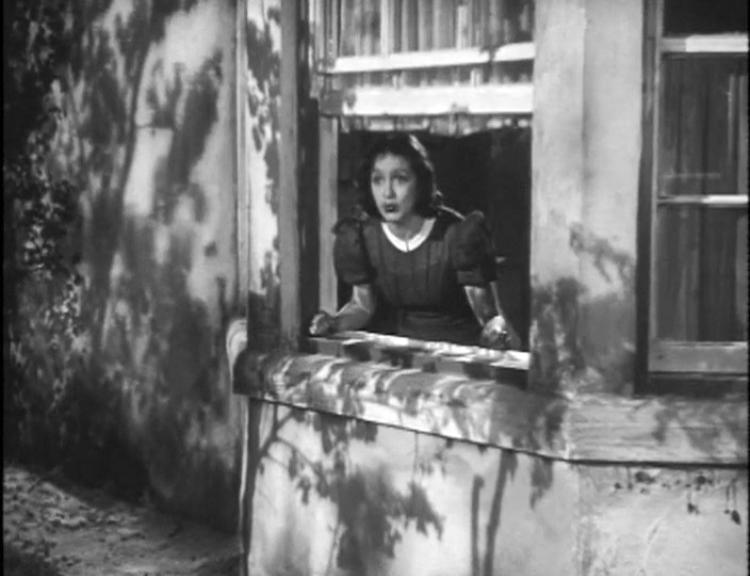
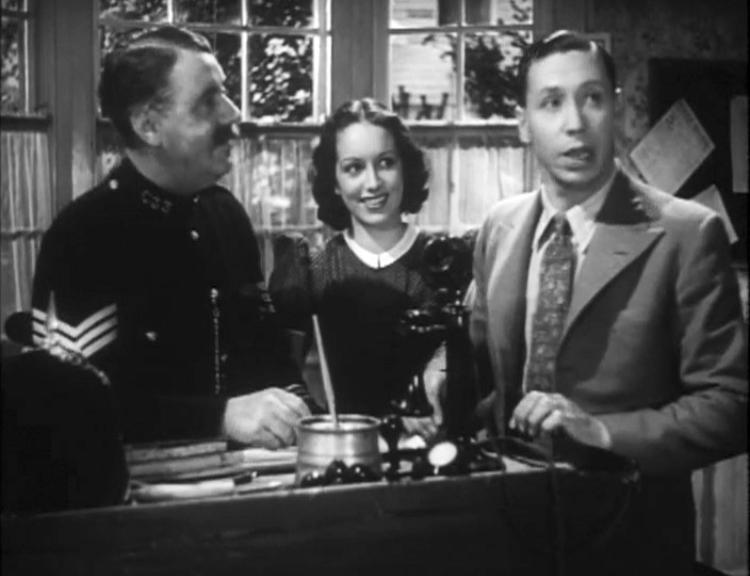
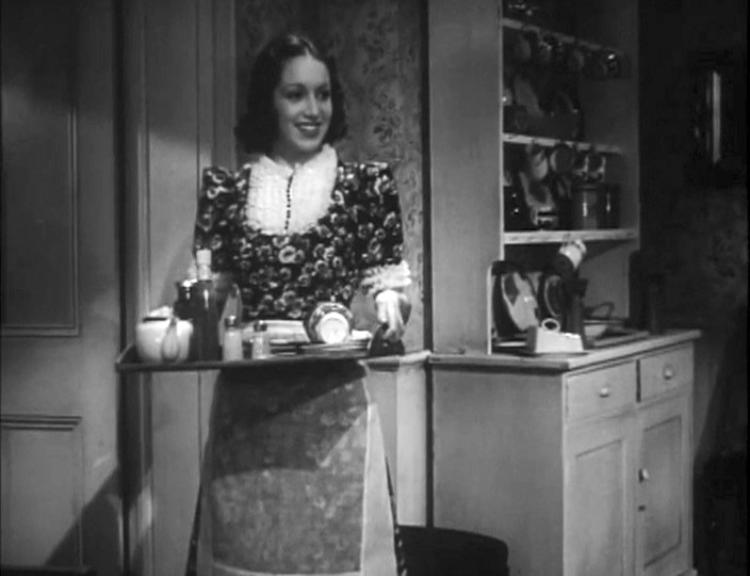
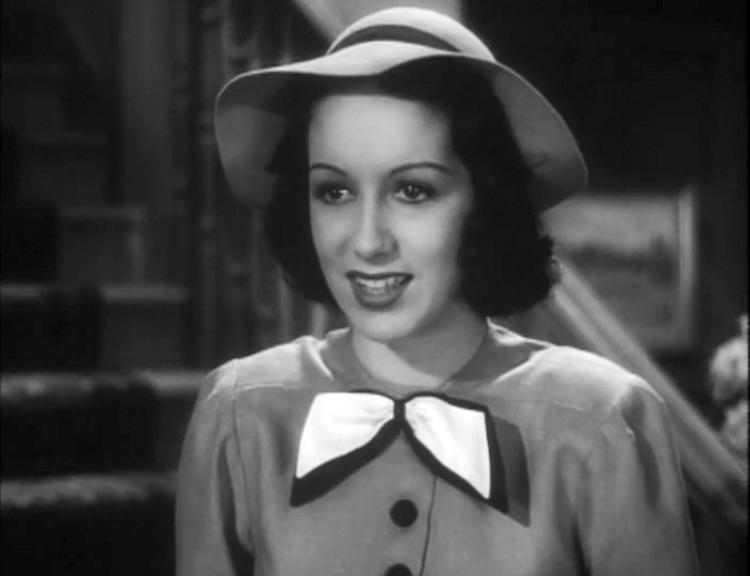
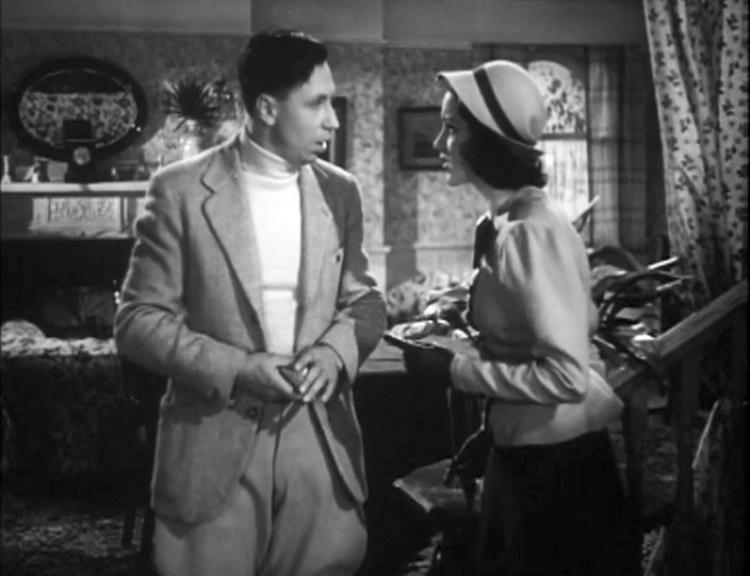
Despite these less than ideal working conditions, Patricia (as her
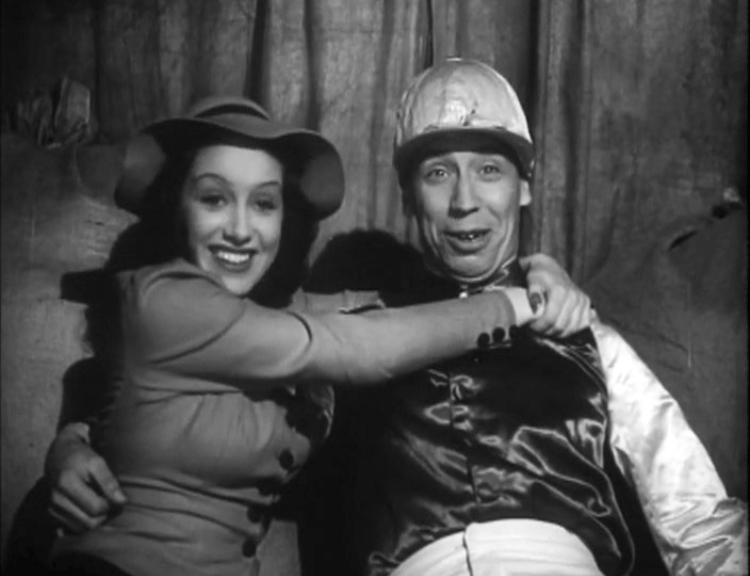
husband, Peter Knight, prefers to call her) sparkles as "Ann Johnson,"
granddaughter of a country constable, worshipped by jockey George.
Her mellifluous speaking voice would sooth the most skittish steed or
suitor, and her modest frocks, however dowdy in real life, set off her
splendid dancer's figure a treat.
A Lancashire lass, Patricia Kirkwood was born February 24, 1921 in
Pendleton, Manchester ("at the Seedley Terrace Nursing Home"),
daughter of William and Norah Carr Kirkwood. When she was 14, an
amateur night performance at a Ramsey, Isle of Man summer resort led
to her first professional appearance on a BBC children's radio show--
sounding "more like 40 than 14," as one of her brother's friends put it.
Five months later, in April 1936, she made her first stage appearance in
Salford, billed as "The Schoolgirl Songstress." Her London debut,
Christmas 1937, was as Dandini in Cinderella with Stanley Lupino.
In 1938, she made two films--Save A Little Sunshine in which she had
two
musical numbers and Me And My Gal--and cut her first record, "Hurry
Home." (Being a very proper young lady, she was invariably chaperoned
by her mother.)
Then Patricia's agent rang to say she was being offered a role opposite
George Formby. "How thrilled mother and I were," she recalls. Despite
being denied a song and losing her beautiful hair, she insists, "I never
had anything but respect for this great man! He was always happy and
cheered up the whole company when he appeared, although he was
obviously afraid of talking to me!"
Her next film, The Band Waggon (1939) with Arthur Askey, was a happier
experience for her. She had two songs, lovely clothes, a sympathetic
director (Marcel Varnel), and the environment on the set was relaxed and
friendly. "Arthur always had the gift of making his colleagues happy..."
1939 was a pivotal year. One night she opened at the London
Hippodrome in Black Velvet. The next morning she was a star. Patricia
introduced Cole Porter's "My Heart Belongs to Daddy" to Britain, and
won acclaim for "Oh, Johnny" (a song she secretly loathed). One critic
called her, "Britain's first war time star...with a personality as inescapable
as sheet lightning and a voice vibrant as a dynamo and as soft as
Deanna Durbin's."
Through World War II, she went from one stage success to another.
There was Top Of The World in 1940. (During rehearsals, Bud Flanagan
of Flanagan and Allan was so unnerved by frequent air raids that he
reportedly hailed a taxi, told the driver "Blackpool," and disappeared for
three days.) "When [the show] opened," she recalled in a 1945 Boston
Globe interview, "the sky was bright with searchlights"--ironically anti-
aircraft searchlights, not the Hollywood kind. "When bombs fell near the
theatre, the show went on. No one left, all stayed in their seats because
the theatre was safer than the streets. The cast would make bets on who
would be onstage when the bombs began to fall."
"My weirdest [war] experience was standing on my roof one night with
my mother. On all sides of us, buildings were burning. We looked
around--a sea of fire. Oddly, our building didn't burn, but we were
marooned. No way out."
Lady Behave in 1941 and Let's Face It in 1942 followed. In between
were pantomimes, cabaret appearances, recordings, another film, and a
radio show called "A Date with Pat Kirkwood." Also a Royal Command
Performance before King George VI and Queen Elizabeth, now the
Queen Mother, and the two Princesses at Windsor Castle.
In 1944, Patricia was simultaneously offered 7-year Hollywood contracts
by MGM and Twentieth Century Fox. Her agent recommended MGM,
and she signed. One newspaper reported, "Pat Kirkwood Signs Up for
£250,000"--all "tarradiddle" she says. She was merely "on option" which
meant steady raises IF the studio kept her. But despite their enthusiasm,
MGM had to wait for her arrival until the war ended. Finally, three days
after VE Day, Patricia and her mother flew to America.
Typically, MGM, which had frequently indicated they could not survive
without her, now had nothing for her to do. After 8 months, she was told
her first film would be No Leave, No Love, and her co-star the very
popular U.S. star Van Johnson. (She had never heard of him.) MGM
now demanded that she lose 10 pounds, and the studio doctor put her
on a highly dangerous regime of salads plus thyroid and pituitary
capsules.
Van Johnson was all kindness. "Don't worry," he told her on the first day
of shooting. "This picture is going to be a real stinker, so we might as
well have a few laughs and forget it." He was right, though Patricia had
three big numbers including the bouncy "Love on a Greyhound Bus."
She got through the film, then suffered a physical collapse that nearly
killed her. MGM wanted her to stay another year, but had no immediate
project for her. Her old friend Ben Lyon, now an executive at Twentieth
Century Fox, renewed their contract offer. However, she decided she'd
had quite enough of Hollywood.
Back in England, she concentrated on the stage. From Starlight Roof
(1947) she recorded the enchanting "Make Mine Allegro." Other big hits
included Ace Of Clubs, written for her by Nöel Coward (1951), Wonderful
Town (1955) by Leonard Bernstein, and her greatest triumph,
Chrysanthemum (1958). More than a dozen productions followed, most
recently Noel/Cole in 1994.
Her many television appearances, from 1939 to 1994, include Our Marie
(with Patricia as music hall artist Marie Lloyd, 1953), The Pat Kirkwood
Show (1954), Pygmalion (1956), The Great Little Tilley (as Vesta Tilley,
1956), directed by her husband Hubert Gregg and turned into the 1957
film, After The Ball, and Pat (a 1968 series).
But there were rough spots too. It is a sad comment on human nature
that an irreproachable private life cannot protect a celebrity from
undeserved scandal. One evening in 1948 she was introduced to and
danced with Prince Philip. A week later, her mother overheard two
women gossiping about how Pat Kirkwood was the Prince's mistress! At
first she laughed at the absurdity, but the ludicrous rumour persisted for
decades and even appeared as fact in a 1996 biography of the Queen.
In the years after WWII, her private life brought her both immense joy
and sorrow. A youthful marriage to John Lister, manager of a theatre in
Blackpool, had ended unhappily, and Patricia determined to remain
single--until nine years later when she met "Sparky"--Spiro de Spero
Gabriele, a Greek-Russian émigré businessman. After a 4-year
engagement, they were married on February 22, 1952. Tragically, just a
month after the death of her father and a few days short of her second
wedding anniversary, her beloved Sparky died in her arms of a coronary.
In 1956 she married the multi talented Hubert Gregg--producer, writer,
composer (including "Maybe It's Because I'm a Londoner"), prolific
broadcaster, and performer. The rewarding personal and professional
partnership lasted more than 20 years, but eventually faded due to
frequent separations. Though determined to remain single, Patricia then
met Peter Knight, a retired lawyer and President of the Bradford &
Bingley Building Society. The couple married in 1981, and now live
happily in Yorkshire.
26 December 2007 - It is reported that Pat has passed away.
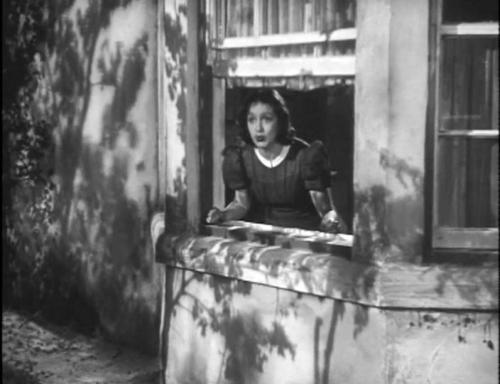
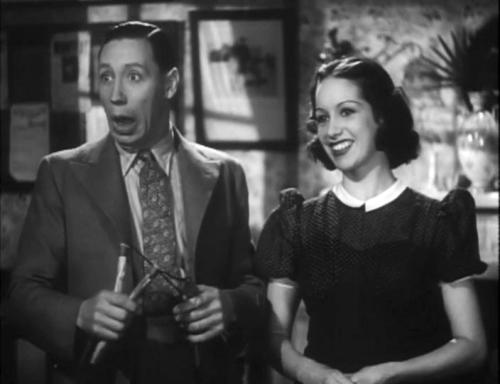
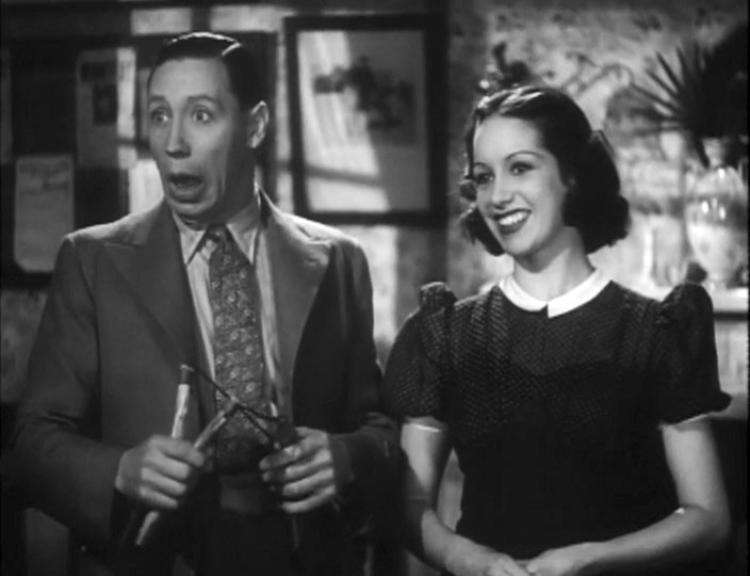
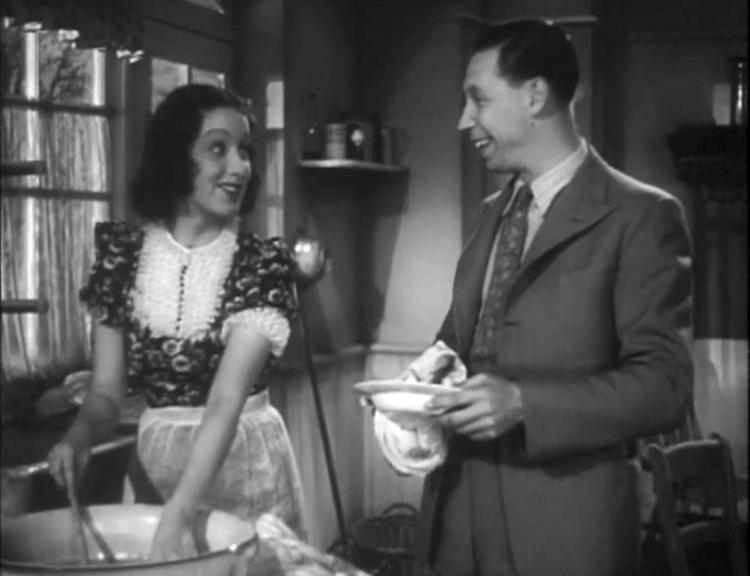
On the set of Come On George in 1939, bewildered Pat Kirkwood
endured the usual Formby leading lady treatment: "no communication
from George Formby--not even a cup of tea or a 'good-morning.'" She
was soon told why. "Our director, a great fellow called Anthony Kimmins,
and his assistant Basil Dearden, later a notable director himself, assured
me that George Formby had probably been warned off me by his wife
Beryl, who was apparently very jealous of George and still madly in love
with him. I felt rather sorry for her in spite of her making me look like a
scarecrow, because she must have suffered a lot of pain.
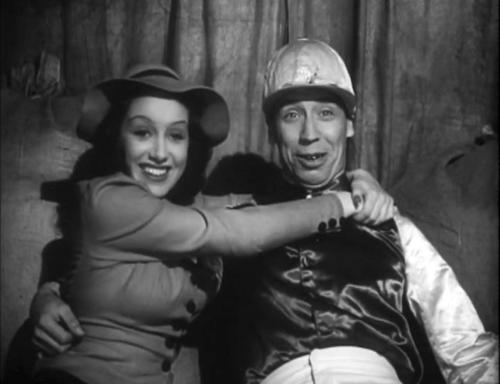
"The final close-up of the film was to be a kiss between George and me,
but in order to achieve this we had to see that Beryl was off the set. [The
director] solved the problem. Someone would leave the studio and
telephone Beryl. 'Telephone call for you, Mrs Formby,' floated through the
set. All was ready to go, and I was instructed by Tony to 'Grab him and
let him have it and don't break till I say "cut".' As I was so utterly fed up
with all these capers, together with losing my locks, looks, and entire
persona, I decided to do just that."
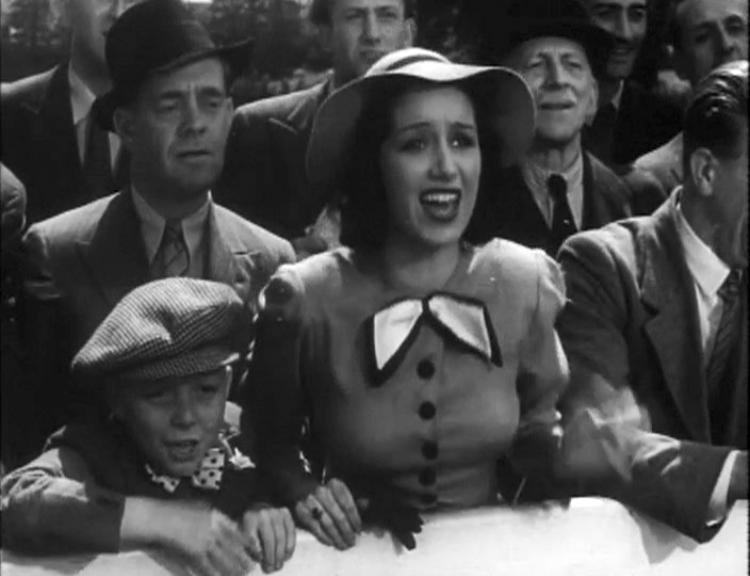
And so the leading lady plants a big kiss slightly west of the Formby
mouth, but that is more than enough for George: "Ayee! What a to-do!"
he whoops gleefully. And every man in the audience fervently wishes he
could have beaten George to the finish line and been the lucky recipient
of Pat Kirkwood's victory kiss.
STAGE ROLES INCLUDE:
1939 - Black Velvet (age 18) *
1940 - The Top of the World
1941 - Lady Behave
1942 - Let's Face It
1943 - Happidrome - 1943 - Humpty Dumpty (pantomime)
1944 - Goody Two Shoes (pantomime)
1947 - Starlight Roof (revue) **
1948 - Humpty Dumpty (pantomime)
1949 - Roundabout - 1949 - Little Miss Muffet (pantomime)
1950 - Ace of Clubs (written for her by Noël Coward)
1951 - Fancy Free (revue)
1954 - American cabaret debut, Desert Inn, Las Vegas ****
1955 - Wonderful Town
1957 - Jack and the Beanstalk (panto)
1958 - Chrysanthemum
1961 - Pool's Paradise - 1961 - Villa Sleep Four - 1961 - Robin Hood (panto)
1970 - Hay Fever (Newcastle)
1971 - Lady Frederick (tour) - 1971 - Babes in the Woods (panto)
1972 - A Chorus Murder
1973 - Move Over, Mrs. Markham (tour) - 1973 - Aladdin (panto)
1976 - Pal Joey (revival, Edinburh Festival)
1977 - The Cabinet Minister (tour)
1983 - An Evening with Pat Kirkwood
1989 - A Talent to Amuse
1993 - Glamourous Nights of Music
1994 - Noël/Cole - Let's Do It, Chichester Festival ***
* "It ran for 2 years at the London Hippodrome, twice nightly plus 2 matinees
each week."
** Ran 22 months.
*** Ran 3 months.
**** Ran 3 months.
FILMS
1938 - Save a Little Sunshine - 1938 - Me and My Pal
1939 - Come On George - 1939 - Band Waggon with Arthur Askey
1944 - Flight from Folly (Palmer says 1945)
1946 - No Leave, No Love
1950 - Once a Sinner
1956 - Stars in Your Eyes
1957 - After the Ball
1977 - To See Such Fun
Eleanor Knowles Dugan
1999
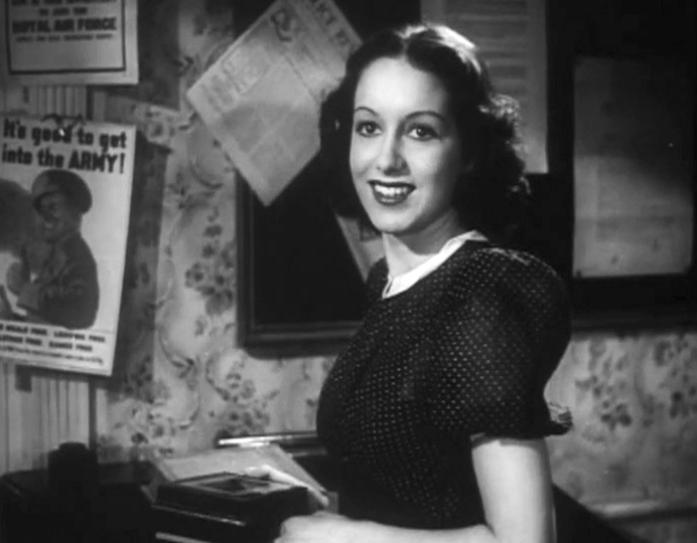






































Star of COME ON GEORGE
When 18-year-old singing
sensation Pat Kirkwood was
signed to appear in Let George
Do It, she assumed she'd have
a solo or two. "No," she was
told. Well, her agent insisted, at
least a duet with George?
Again, "No."
This was just the beginning.
Although Miss Kirkwood had
already appeared in two films,
Beryl Formby insisted that her
long hair had to be cropped, her
glamorous makeup subdued,
and her wardrobe confined to
"country jumble sale" rejects.
Not knowing about Beryl's
jealousy, she attributed George
Formby's reticence on the set to
her "frightening" appearance.
Despite these less than ideal
working conditions, Patricia (as
her husband, Peter Knight,
prefers to call her) sparkles as
"Ann Johnson," granddaughter
of a country constable,
worshipped by jockey George.
Her mellifluous speaking voice
would sooth the most skittish
steed or suitor, and her modest
frocks, however dowdy in real
life, set off her splendid
dancer's figure a treat.
A Lancashire lass, Patricia
Kirkwood was born February
24, 1921 in Pendleton,
Manchester ("at the Seedley
Terrace Nursing Home"),
daughter of William and Norah
Carr Kirkwood. When she was
14, an amateur night
performance at a Ramsey, Isle
of Man summer resort led to her
first professional appearance on
a BBC children's radio show--
sounding "more like 40 than
14," as one of her brother's
friends put it. Five months later,
in April 1936, she made her first
stage appearance in Salford,
billed as "The Schoolgirl
Songstress." Her London debut,
Christmas 1937, was as
Dandini in Cinderella with
Stanley Lupino.
In 1938, she made two films--
Save A Little Sunshine in which
she had two
musical numbers and Me And
My Gal--and cut her first record,
"Hurry Home." (Being a very
proper young lady, she was
invariably chaperoned by her
mother.)
Then Patricia's agent rang to
say she was being offered a
role opposite George Formby.
"How thrilled mother and I
were," she recalls. Despite
being denied a song and losing
her beautiful hair, she insists, "I
never had anything but respect
for this great man! He was
always happy and cheered up
the whole company when he
appeared, although he was
obviously afraid of talking to
me!"
Her next film, The Band
Waggon (1939) with Arthur
Askey, was a happier
experience for her. She had two
songs, lovely clothes, a
sympathetic director (Marcel
Varnel), and the environment on
the set was relaxed and
friendly. "Arthur always had the
gift of making his colleagues
happy..."
1939 was a pivotal year. One
night she opened at the London
Hippodrome in Black Velvet.
The next morning she was a star. Patricia introduced Cole Porter's
"My Heart Belongs to Daddy" to Britain, and won acclaim for "Oh,
Johnny" (a song she secretly loathed). One critic called her,
"Britain's first war time star...with a personality as inescapable as
sheet lightning and a voice vibrant as a dynamo and as soft as
Deanna Durbin's."
Through World War II, she went from one stage success to another.
There was Top Of The World in 1940. (During rehearsals, Bud
Flanagan of Flanagan and Allan was so unnerved by frequent air
raids that he reportedly hailed a taxi, told the driver "Blackpool,"
and disappeared for three days.) "When [the show] opened," she
recalled in a 1945 Boston Globe interview, "the sky was bright with
searchlights"--ironically anti-aircraft searchlights, not the Hollywood
kind. "When bombs fell near the theatre, the show went on. No one
left, all stayed in their seats because the theatre was safer than the
streets. The cast would make bets on who would be onstage when
the bombs began to fall."
"My weirdest [war] experience was standing on my roof one night
with my mother. On all sides of us, buildings were burning. We
looked around--a sea of fire. Oddly, our building didn't burn, but we
were marooned. No way out."
Lady Behave in 1941 and Let's Face It in 1942 followed. In
between were pantomimes, cabaret appearances, recordings,
another film, and a radio show called "A Date with Pat Kirkwood."
Also a Royal Command Performance before King George VI and
Queen Elizabeth, now the Queen Mother, and the two Princesses
at Windsor Castle.
In 1944, Patricia was simultaneously offered 7-year Hollywood
contracts by MGM and Twentieth Century Fox. Her agent
recommended MGM, and she signed. One newspaper reported,
"Pat Kirkwood Signs Up for £250,000"--all "tarradiddle" she says.
She was merely "on option" which meant steady raises IF the
studio kept her. But despite their enthusiasm, MGM had to wait for
her arrival until the war ended. Finally, three days after VE Day,
Patricia and her mother flew to America.
Typically, MGM, which had frequently indicated they could not
survive without her, now had nothing for her to do. After 8 months,
she was told her first film would be No Leave, No Love, and her co-
star the very popular U.S. star Van Johnson. (She had never heard
of him.) MGM now demanded that she lose 10 pounds, and the
studio doctor put her on a highly dangerous regime of salads plus
thyroid and pituitary capsules.
Van Johnson was all kindness. "Don't worry," he told her on the first
day of shooting. "This picture is going to be a real stinker, so we
might as well have a few laughs and forget it." He was right, though
Patricia had three big numbers including the bouncy "Love on a
Greyhound Bus."
She got through the film, then suffered a physical collapse that
nearly killed her. MGM wanted her to stay another year, but had no
immediate project for her. Her old friend Ben Lyon, now an
executive at Twentieth Century Fox, renewed their contract offer.
However, she decided she'd had quite enough of Hollywood.
Back in England, she concentrated on the stage. From Starlight
Roof (1947) she recorded the enchanting "Make Mine Allegro."
Other big hits included Ace Of Clubs, written for her by Nöel
Coward (1951), Wonderful Town (1955) by Leonard Bernstein, and
her greatest triumph, Chrysanthemum (1958). More than a dozen
productions followed, most recently Noel/Cole in 1994.
Her many television appearances, from 1939 to 1994, include Our
Marie (with Patricia as music hall artist Marie Lloyd, 1953), The Pat
Kirkwood Show (1954), Pygmalion (1956), The Great Little Tilley
(as Vesta Tilley, 1956), directed by her husband Hubert Gregg and
turned into the 1957 film, After The Ball, and Pat (a 1968 series).
But there were rough spots too. It is a sad comment on human
nature that an irreproachable private life cannot protect a celebrity
from undeserved scandal. One evening in 1948 she was introduced
to and danced with Prince Philip. A week later, her mother
overheard two women gossiping about how Pat Kirkwood was the
Prince's mistress! At first she laughed at the absurdity, but the
ludicrous rumour persisted for decades and even appeared as fact
in a 1996 biography of the Queen.
In the years after WWII, her private life brought her both immense
joy and sorrow. A youthful marriage to John Lister, manager of a
theatre in Blackpool, had ended unhappily, and Patricia determined
to remain single--until nine years later when she met "Sparky"--
Spiro de Spero Gabriele, a Greek-Russian émigré businessman.
After a 4-year engagement, they were married on February 22,
1952. Tragically, just a month after the death of her father and a
few days short of her second wedding anniversary, her beloved
Sparky died in her arms of a coronary.
In 1956 she married the multi talented Hubert Gregg--producer,
writer, composer (including "Maybe It's Because I'm a Londoner"),
prolific broadcaster, and performer. The rewarding personal and
professional partnership lasted more than 20 years, but eventually
faded due to frequent separations. Though determined to remain
single, Patricia then met Peter Knight, a retired lawyer and
President of the Bradford & Bingley Building Society. The couple
married in 1981, and now live happily in Yorkshire.
26 December 2007 - It is reported that Pat has passed away.
On the set of Come On George in 1939, bewildered Pat Kirkwood
endured the usual Formby leading lady treatment: "no
communication from George Formby--not even a cup of tea or a
'good-morning.'" She was soon told why. "Our director, a great
fellow called Anthony Kimmins, and his assistant Basil Dearden,
later a notable director himself, assured me that George Formby
had probably been warned off me by his wife Beryl, who was
apparently very jealous of George and still madly in love with him. I
felt rather sorry for her in spite of her making me look like a
scarecrow, because she must have suffered a lot of pain.
"The final close-up of the film was to be a kiss between George and
me, but in order to achieve this we had to see that Beryl was off the
set. [The director] solved the problem. Someone would leave the
studio and telephone Beryl. 'Telephone call for you, Mrs Formby,'
floated through the set. All was ready to go, and I was instructed by
Tony to 'Grab him and let him have it and don't break till I say "cut".'
As I was so utterly fed up with all these capers, together with losing
my locks, looks, and entire persona, I decided to do just that."
And so the leading lady plants a big kiss slightly west of the Formby
mouth, but that is more than enough for George: "Ayee! What a to-
do!" he whoops gleefully. And every man in the audience fervently
wishes he could have beaten George to the finish line and been the
lucky recipient of Pat Kirkwood's victory kiss.
STAGE ROLES INCLUDE:
1939 - Black Velvet (age 18) *
1940 - The Top of the World
1941 - Lady Behave
1942 - Let's Face It
1943 - Happidrome - 1943 - Humpty Dumpty (pantomime)
1944 - Goody Two Shoes (pantomime)
1947 - Starlight Roof (revue) **
1948 - Humpty Dumpty (pantomime)
1949 - Roundabout - 1949 - Little Miss Muffet (pantomime)
1950 - Ace of Clubs (written for her by Noël Coward)
1951 - Fancy Free (revue)
1954 - American cabaret debut, Desert Inn, Las Vegas ****
1955 - Wonderful Town
1957 - Jack and the Beanstalk (panto)
1958 - Chrysanthemum
1961 - Pool's Paradise - 1961 - Villa Sleep Four - 1961 - Robin
Hood (panto)
1970 - Hay Fever (Newcastle)
1971 - Lady Frederick (tour) - 1971 - Babes in the Woods (panto)
1972 - A Chorus Murder
1973 - Move Over, Mrs. Markham (tour) - 1973 - Aladdin (panto)
1976 - Pal Joey (revival, Edinburh Festival)
1977 - The Cabinet Minister (tour)
1983 - An Evening with Pat Kirkwood
1989 - A Talent to Amuse
1993 - Glamourous Nights of Music
1994 - Noël/Cole - Let's Do It, Chichester Festival ***
* "It ran for 2 years at the London Hippodrome, twice nightly plus 2
matinees
each week."
** Ran 22 months.
*** Ran 3 months.
**** Ran 3 months.
FILMS
1938 - Save a Little Sunshine - 1938 - Me and My Pal
1939 - Come On George - 1939 - Band Waggon with Arthur Askey
1944 - Flight from Folly (Palmer says 1945)
1946 - No Leave, No Love
1950 - Once a Sinner
1956 - Stars in Your Eyes
1957 - After the Ball
1977 - To See Such Fun
Eleanor Knowles Dugan
1999