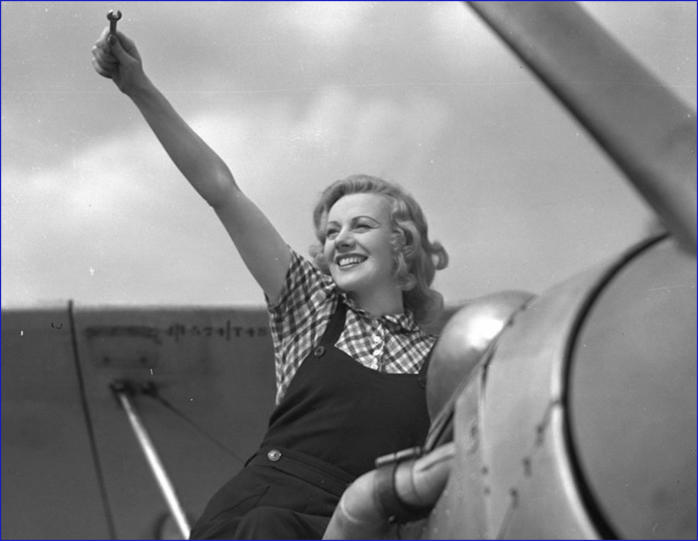
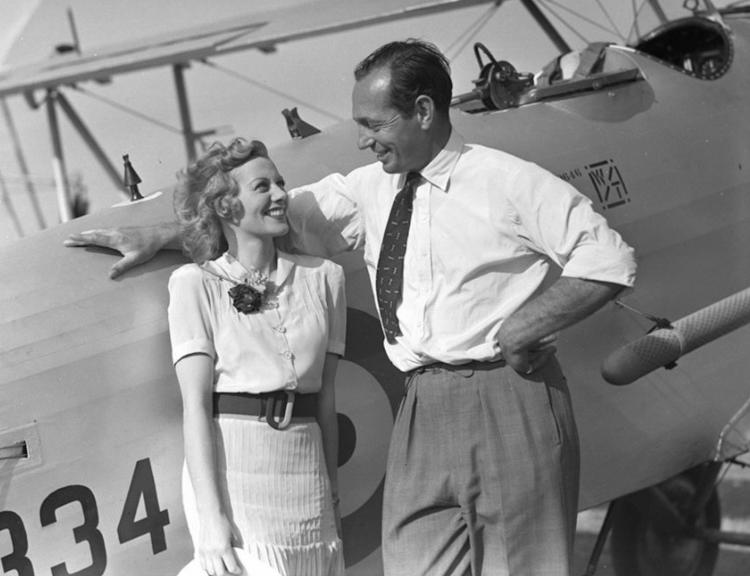
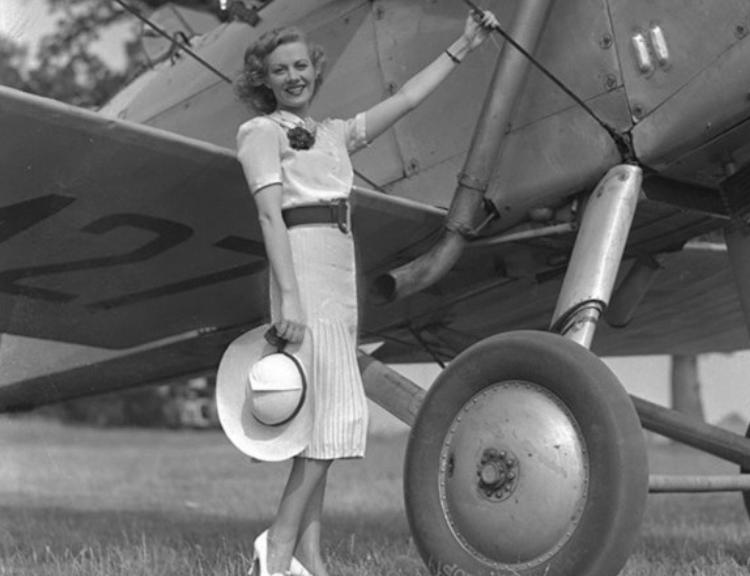
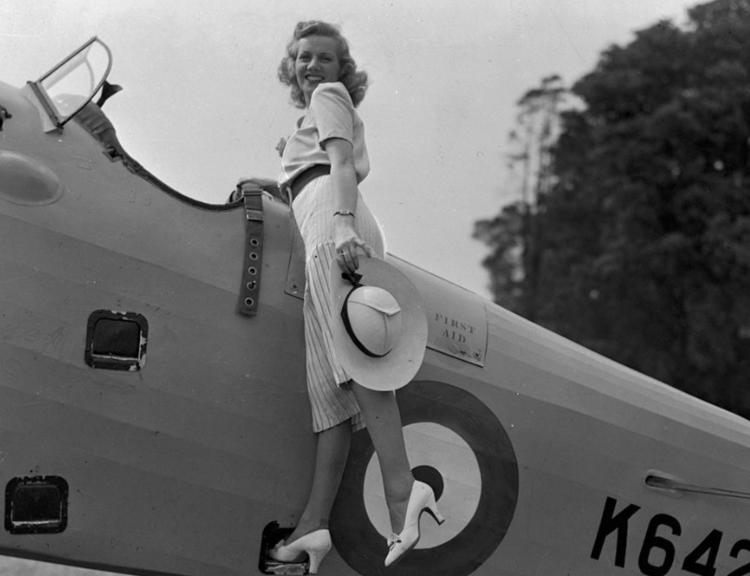
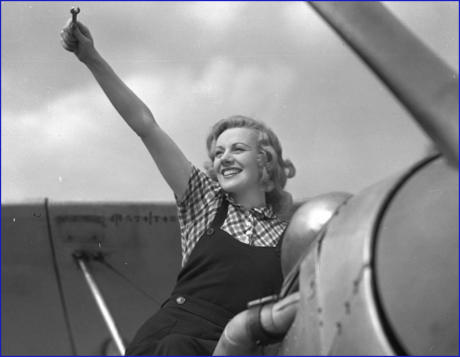
Star of FEATHER YOUR NEST and IT'S IN THE AIR
Polly Ward is yet another talented singer-dancer who warbled not a note
nor trod a single time-step as George's leading lady. She was also a
member of the exclusive two-timer club, one of four leading ladies who
appeared in more than one film with George. (The others are Florence
Desmond, Kay Walsh, and George's wife Beryl).
Polly had the distinction of starring in the second UK film musical,
Harmony Heaven, in 1930. (Song of Soho with Carl Brisson opened a
week earlier.) An adorably pert, saucer-eyed brunette, she lit up the
screen and danced up a storm. As her show biz career progressed, she
became a rather bland-looking blonde, playing mostly supporting roles.
Still, she sparkled, and one reviewer called her "the Ginger Rogers of
England."
Born Bino (or Byno) Poluski on June 30, 1908 (or 1909 or 1912) in
Mitchum Surrey, Polly possessed a flawless thespian pedigree. Her father
was one of the Poluski brothers, from a theatrical and circus family going
back to Shakespeare's time. Her mother, Winnifred Ward, was a famous
music hall artist and male impersonator who died in 1975 at the age of 95.
("Ward" may have been a contraction of Winnifred's maiden name,
"Howard.") Polly's maternal uncle was character actor Gus McNaughton
who appeared in numerous Formby films. McNaughton, born Howard,
was married to Polly's paternal aunt Charlotta Poluski. Her grandmother,
Nellie Waite, worked for many years with Henry Irving. And Polly Ward's
aunt (or great-aunt) was the venerated actress Marie Lloyd.
She attended Kensington High School and possibly the Conte School of
theatrical arts. One edition of Who's Who in the Theatre says that she
made her first stage appearance at the Prince of Wales's Theatre in 1924,
when, as one of the "Cousin Sisters" she appeared with Doris Bentley and
"The Co-Optimists." A different edition puts her debut at the Duke of York,
May 21, 1924, under the name Bino Poluski in The Punch Bowl, launched
by the Conte School. Her first real chance came when she understudied
Jessie Matthews in Wake Up and Dream (as did another Formby leading
lady, Marjorie Browne).
In Feather Your Nest (1937), Polly plays "Mary Taylor," fiancée to
George's "Willie." Although she must tote George's uke case, she is a
proactive part of the plot from the beginning. She gets to do a lot of
running and falling, even riding on George's motorcycle, and it is she who
engineers a jailbreak that lets George claim a lucrative recording
contract.They wed, but her reward is not a finale kiss. Instead, George
stumbles and drops his lavishly gowned bride in a mud puddle.
It's in the Air (1938) must have been even more frustrating for the singer-
dancer. An invitation for her to sing a duet is refused by her jealous beau
(Jack Hobbs), she remains silent during a large group sing-song, and she
can only blow kisses to George from the audience when he stars in the
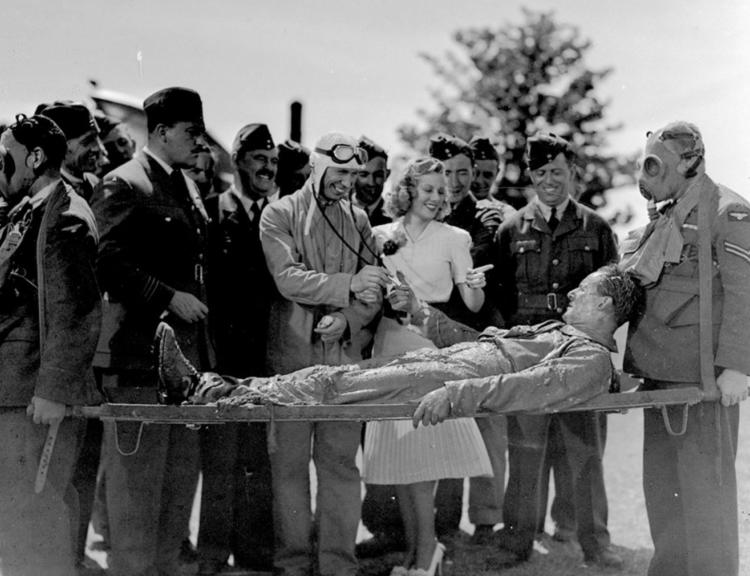
camp show. The plot has civilian George turned down for military service,
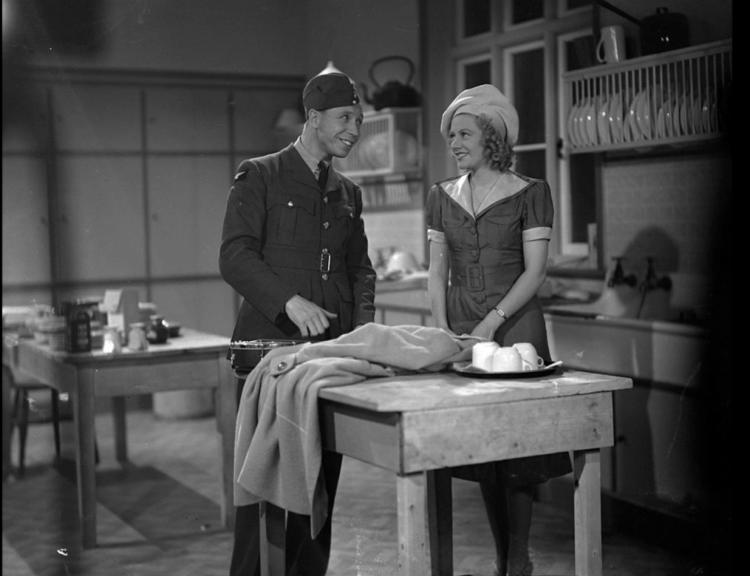
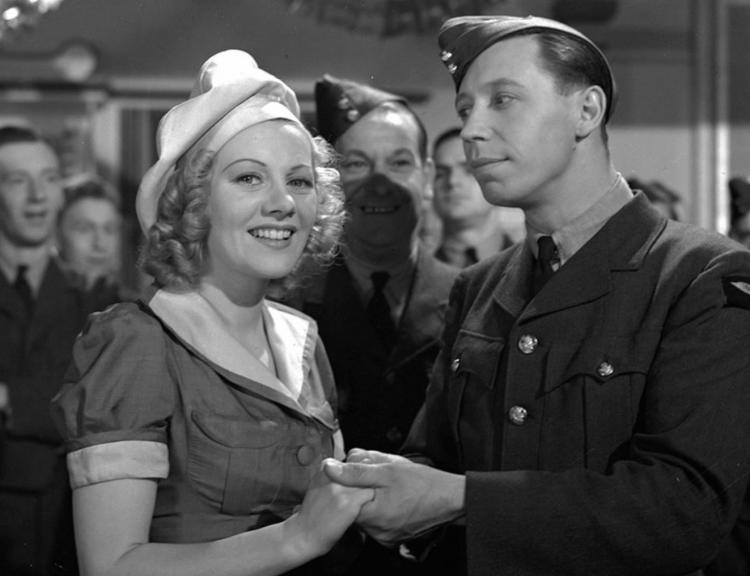
so of course he accidentally ends up in uniform on an air force base. Polly
plays "Peggy," a pretty canteen attendant and daughter of the Sergeant-
Major. At first, she goes along with the sadistic practical jokes played on
this newcomer by her beau, but then relents and decides she loves
George. Although she talks George through landing a plane by radio, her
part could literally be cut entirely without affecting the story. As to physical
contact, at one point George wrestles her to the ground, thinking he is
saving her from machine gun fire. At another, she kisses his cheek,
mistaking him for her father in a darkened bedroom. However, the lip-lock
score is a solid zero.
Interviewed in Fanfare Film magazine in the late 1930s, Polly Ward cited
Carole Lombard, Claudette Colbert, James Cagney, Spender Tracy, and
William Powell as her favourite stars, while her favourite writers were E.
Linklater, Macdonnell, and Marcus Aurelius. She said she disliked New
York City taxi drivers and film make-up, but loved to sing in the bathtub.
In later years, she was known as Winifred Charlotte (Polly) Freeman, and
lived in Surrey with her husband, Robert S. Freeman. She died February
23 (or 24), 1987. Her obituary described her as "a past Queen Ratling" of
the historic theatrical society, The Grand Order of Water Rats, indicating
she was held in high esteem in her profession. A talented and spirited
performer, under-used but much appreciated as a Formby leading lady.
FILMS:1927 - This Marriage Business
1928 - Shooting Stars
1930 - Harmony Heaven - 1930 - Alf's Button
1932 - His Lordship
1934 - Kentucky Minstrels - 1934 - The Old Curiosity Shop/Mr. Quip
1935 - It's a Bet
1936 - Shipmates O'Mine - 1936 - Annie Laurie - 1936 - Show Flat
1937 - Television Talent - 1937 - Feather Your Nest
1938 - Thank Evans - 1938 - St. Martin's Lane/Sidewalks of London
1938 - Hold My Hand - 1938 - It's in the Air
1940 - Bulldog Sees It Through
1942 - Women Aren't Angels
1954 - New Faces
STAGE CREDITS:
1924 - The Punch Bowl
1925 - The Five O'Clock Follies
1926 - Vaudeville Vanities
1927 - C.O.D.1927 - in variety as "Bino" of The Trix Sisters (replacing
Helen Trix'ssister Josephine)
1928 - The Song of the Sea
1929 - Wake Up and Dream
1930 - Heads Up
1932 - Savoy Follies - 1932 - Here We Are Again
1934 - Aladdin (panto)1935 - The Forty Thieves (panto)
1936 - Puss in Boots (panto)
1937 - Twelfth Night (as Maria)
1938 - Red Riding Hood (panto)
1939 - No. 19 (tour)
1940 - Co-Optimists of 1940 (tour)
1941 - Orchids and Onions1941 - The Babes in the Wood (panto)
1942 - Mixed Relations- 1942 - The Babes in the Wood (panto)
1945 - Hoopla! (Blackpool)
1949 - Me and My Girl (revival)
Eleanor Knowles Dugan
1999